
This article was published in Scientific American’s former blog network and reflects the views of the author, not necessarily those of Scientific American
After more than ten years in orbit around Saturn, the Cassini mission is making some of its final housecalls before a "Grand Finale" in 2017 when it will plunge into Saturn's atmosphere.
Among these orbital maneuvers are the last three flybys to the icy moon Enceladus - one of the most extraordinary places in our solar system, an environment where an internal liquid water ocean regularly erupts to the surface, creating Saturn's vast E-ring. Thanks to Cassini's observations and discoveries this 500 kilometer diameter moon has become of the major astrobiology focus points of solar system exploration.
The most exciting flyby is likely to be on October 28th when Cassini swoops to within 49 kilometers (30 miles) of the active southern polar region on Enceladus - home to its geysers. But Cassini has just visited the northern polar region in an October 14th pass that brought it within 1,900 kilometers of the surface, enabling a set of unprecendented images to be obtained of this part of the moon.
On supporting science journalism
If you're enjoying this article, consider supporting our award-winning journalism by subscribing. By purchasing a subscription you are helping to ensure the future of impactful stories about the discoveries and ideas shaping our world today.
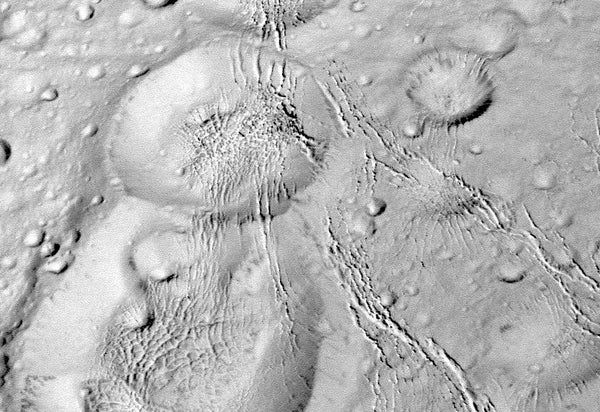
Other areas on the moon's surface were known to be covered in a network of cracks or fissures in the ice. Now it appears that these features extend all the way to the far north, and they exhibit a remarkable pattern of thin 'slice' like crevices in close packed arrays. The north of Enceladus is also more heavily cratered - suggesting a slightly older region that hasn't been 'refreshed' by cryovolcanism or ice tectonics. But the web-like networks of cracks appear to overlay - or be embedded in - the crater features in most cases.
What does this all mean? It's not yet clear, but these features could be closely tied to the interior ocean and the movement and history of Enceladus's icy shell. In that sense they offer hope for further insight to the deeper mechanics of this remarkable moon.
Here are a number of the Cassini northern flyby images, some have not been processed (corrected for exposure and the motion effects of the spacecraft), and they cover various parts of the electromagnetic spectrum, including ultraviolet, infrared, and visible light.
.jpg?w=1350)
Northern latitudes - image in visible + UV light with the Cassini spacecraft narrow-angle camera on Oct. 14, 2015 at a distance of approximately 6,000 miles (10,000 kilometers) from Enceladus. Image scale is 197 feet (60 meters) per pixel (Credit: NASA/JPL-Caltech/Space Science Institute).

Uncalibrated image showing crack networks. Visible and infrared bands (Credit:NASA/JPL-Caltech/Space Science Institute).

Uncalibrated image showing crack networks. Visible and infrared bands (Credit:NASA/JPL-Caltech/Space Science Institute).