
This article was published in Scientific American’s former blog network and reflects the views of the author, not necessarily those of Scientific American
Mars is a very dusty world. Having spent most of the past few billions of years in an extremely dry and frigid state its rocks just keep on eroding to tiny particles. And with sizes as small as individual talcum powder grains (about 3 microns) and a lower surface gravity than Earth, even the thin martian atmosphere can loft these particles high into the sky.
Most of the time the lofting and rearranging of dust is done by the dust devils that spin across the planetary surface. At any given moment on Mars there are an estimated 10,000 or so active dust devils. Imaging data can reveal the tracks left by some of these on the martian landscape, and barometric data from landers also provides clues to their occurrence rates. During the course of a single martian day there may be several million of these swirling dervishes – each popping up for a few minutes at a time.

Dust devil tracks on Mars, seen by HiRISE instrument. Credit: NASA, JPL and University of Arizona
On supporting science journalism
If you're enjoying this article, consider supporting our award-winning journalism by subscribing. By purchasing a subscription you are helping to ensure the future of impactful stories about the discoveries and ideas shaping our world today.
Not only do they maintain a dust load in the atmosphere (where the particles help warm the air and influences global climate), they also rearrange the dust. It’s a bit like having a vast army of rather incompetent cleaners, siphoning up dust from one place and simply depositing it somewhere else. Unlike Earth, with a wet biosphere that washes dust from the atmosphere and helps bind rock particles into soil and sediments, dust on Mars is more or less eternal.
Although not fully understood, it also seems likely that the movement of dust grains generates electrical potentials – high enough perhaps for lightning-like discharges, and certainly enough to make the dust extra sticky for any robotic or human exploration.
But dust devils are typically highly localized phenomena. Mars also experiences dust storms on much grander scales. During the southern spring and summer on Mars, coinciding with the closest approach to the Sun in the elliptical martian orbit, storms are common. At this distance there is 45 percent more solar radiation hitting Mars than at its farthest from the Sun.
There’s a double-barreled driver for these seasonal storms: The atmosphere warms up and winds get stronger, driven by greater contrasts in surface temperature. And frozen carbon dioxide on the southern polar cap sublimates, raising the global atmospheric pressure. A thicker atmosphere means a longer hang time for dust particles, and storms can loft material up to over 60 kilometers altitude.
To add insult to planetary injury, it seems possible that dust storms can contribute to the drying out of Mars. Grains can carry water molecules to high enough altitudes that sunlight breaks molecular bonds, hydrogen escapes to space and those water molecules can never reform.
Although they’re large these seasonal storms generally remain confined to a particular geographical area. For example, the great Hellas Basin in the south. But about every 3 martian years (about 5.5 Earth years) they can explode into global events – in other words a roughly one-in-three probability in a given year. Even though the windspeeds are never shocking by Earth standards, perhaps hitting 60 miles an hour (96 km an hour), the entire planet can become enshrouded by dust in just days.
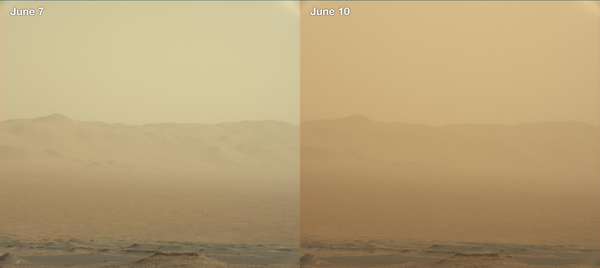
As I write this, Mars is in the midst of just such a global storm. The rovers Curiosity and Opportunity are having to sit through it – a much bigger challenge for the solar-powered Opportunity than the radioisotope-powered Curiosity. Indeed, Curiosity can keep up its exploration program beneath the darkened skies.
Over the years we’ve seen many examples of these global events. Perhaps the most memorable one was actually the first seen up-close. When Mariner 9 became the first probe to orbit another planet in 1971 it happened to arrive precisely when Mars was utterly blanketed in a dust storm. I wrote about this a while back, and how the mission science had to be put on hold for two months until the storm cleared.
Another particularly huge storm took place in 2001, this time seen by NASA’s Mars Global Surveyor. During this one, while the lower to middle atmosphere actually warmed up by about 40 Kelvin, the planet’s surface temperature plunged by as much as 20 Kelvin. All the dust blocked sunlight from warming the ground.
That surface cooling might be extremely challenging for robots or humans on the surface of Mars, but it also presages the end of the storm itself. A cooler surface generates less of the lofting winds, and so by the time the storm’s presence has chilled the ground it’s pretty much doomed itself.
Why do these global storms spring up on Mars in the first place? Well, we don’t really understand the precise mechanism that makes some storms so much bigger than others. But each time we get to witness one we can gather more data to probe this ancient, harsh, and extraordinarily beautiful world.
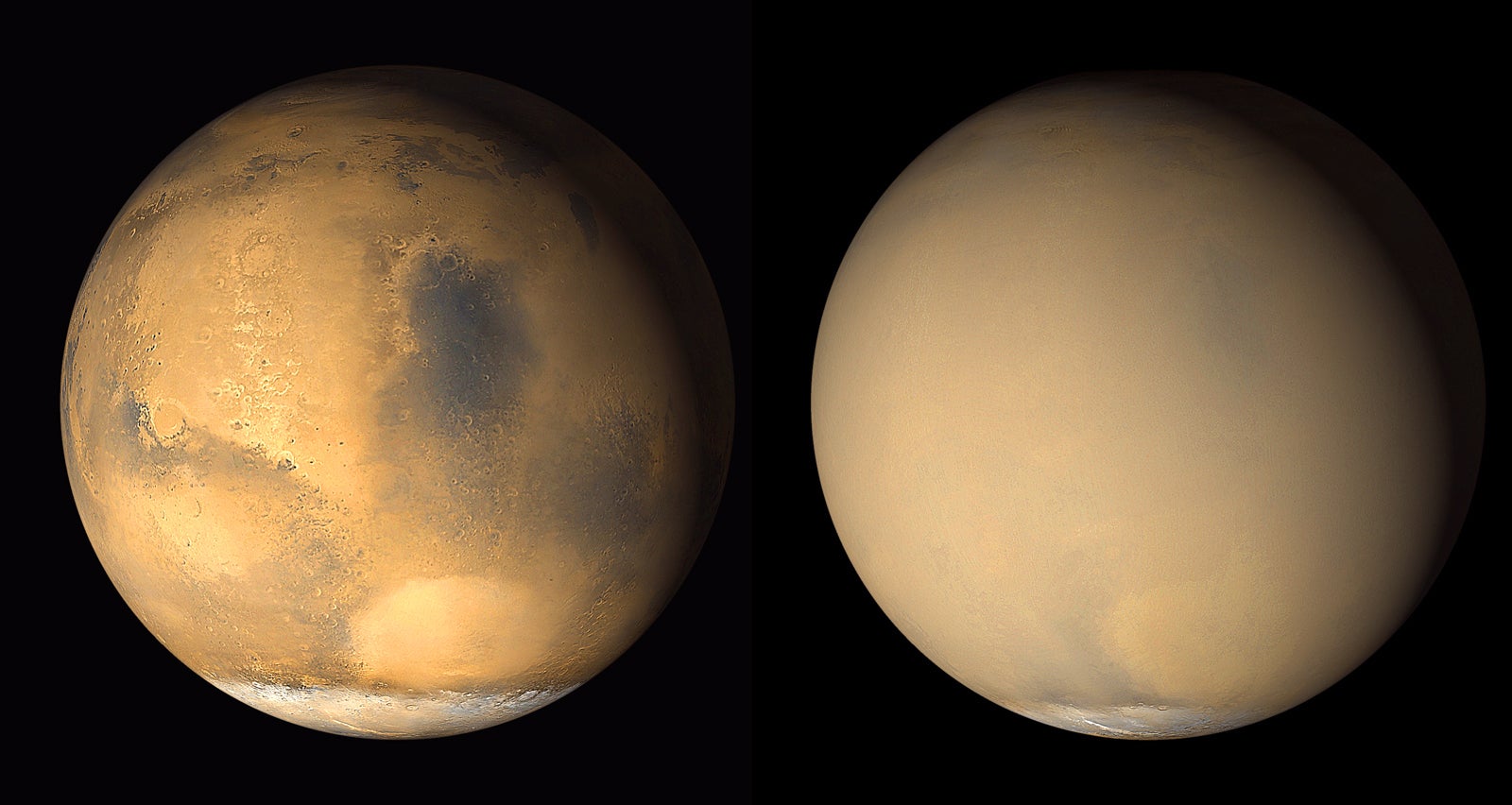
Mars Global Surveyor images of Mars in 2001, before and during its global dust storm. Credit: NASA, JPL-Caltech and MSSS