
This article was published in Scientific American’s former blog network and reflects the views of the author, not necessarily those of Scientific American
Although we've only just begun to see the scientific return from NASA's New Horizons and its close encounter with the Pluto-Charon system, this has been an unexpectedly profound moment for human exploration.
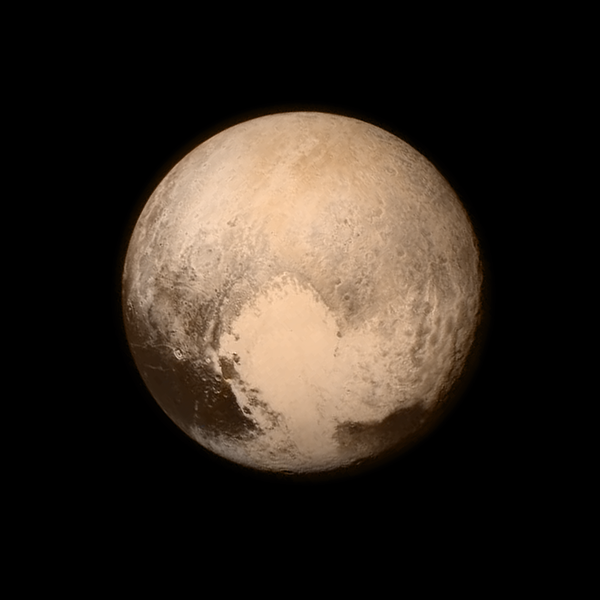
The images returned just 24 hours out from closest approach are already rich with information. A very simple example can be seen in this false-color composite, using 3 filters. Pluto and Charon are wonderfully variegated, with different regions exhibiting clearly different optical (and presumably compositional) properties - including surfaces of frozen methane and nitrogen. Charon is also revealed in stunning detail - its dark northern polar cap possibly a sign of hydrocarbon deposits - including tholins.

Credit: NASA/Johns Hopkins University Applied Physics Laboratory/Southwest Research Institute.
On supporting science journalism
If you're enjoying this article, consider supporting our award-winning journalism by subscribing. By purchasing a subscription you are helping to ensure the future of impactful stories about the discoveries and ideas shaping our world today.
Pluto's atmosphere also appears to extend further than anticipated - with traces of ionized nitrogen hitting the spacecraft a full five days out from close encounter. Perhaps this was a stray wisp, but it raises intriguing questions about the gas source.
More and more revelations about these distant worlds are likely to come over the following months as New Horizons' hard won data is telemetered back to Earth.
But, like a groggy partygoer on the morning afterwards, we're waking up to a changed solar system in other ways too.
Whatever the silly controversies about Pluto's planetary status over the years, the simple fact is that for the better part of a century it has been held up in the popular consciousness as 'the ninth planet'. Regardless of whether or not that's a fully accurate scientific categorization, Pluto has formed an integral piece of the 20th Century's conceptualization of the solar system. It's been the 'last' world, the 'edge', a representative of the end of the known, and the beginning of the great unknown.
In that sense Pluto has served a critical role in helping educate our species. It's been the cork, the thing that stoppers our most simplistic visions of the bottle we're bobbing through the cosmos in. Get to Pluto and you've seen it all.
Of course we now know that Pluto lies within a whole new realm, the dimly lit zone of the Kuiper Belt. Here there are roughly a hundred thousand objects that are larger than 100 kilometers across, including some comparable in size to Pluto. This terrain extends from Neptune's orbit to perhaps 50 times the distance of the Earth from the Sun. And beyond that is the putative Öpik-Oort cloud, the likely repository of ice-rich planetesimals from the early era of solar system formation. The proper 'end' of the solar system? Perhaps a full light year out from the Sun.
Yet, would we have mounted a mission as ambitious as New Horizons to go and explore these outer regions if we hadn't long loved and cherished Pluto?
When Clyde Tombaugh spotted Pluto's faint moving dot in a set of photographic plates in 1930 it was big news. Some astronomers had expected, or hoped for, a mysterious 'Planet X', and while Pluto wasn't what they were really thinking of, it made for a terrifically compelling story that the solar system was somehow now complete.
It stood to reason that eventually we'd want to pay a visit, to check off the last item in our shopping list. It's fascinating how big a motivation that is. Compare the encounter with Pluto and the ongoing encounter with the dwarf planet Ceres orbiting in the zone between Mars and Jupiter. Both are rightfully big news, and Ceres is - in many respects - just as mysterious and exciting as Pluto. But I doubt many of us feel quite the same frisson with Ceres as we do with Pluto.
So it's a wonderful thing that the accidents of history have left us with a soft spot for a small frigid world some 3 billion miles away, because otherwise we might never have tried something as crazy as visiting it.
And it may be a long time before we visit again, so goodbye Pluto, thanks for everything.