
This article was published in Scientific American’s former blog network and reflects the views of the author, not necessarily those of Scientific American
Spin rate is a surprisingly important piece of information to have on hand when trying to understand planets. In our own solar system planetary spins vary dramatically, from slow (and even retrograde) spinners like Venus, with its leisurely 243 Earth-day rotation period, to Jupiter with an average spin rate of once every 9.5 hours.
Planetary spin can help us understand the history of a world. For example, whether or not it's been slowed by gravitational tides or coerced into unexpected tilts and rotations by collisions or orbital resonances and torque-inducing perturbations. Spin is also a critical component in understanding the atmospheric dynamics of planets, since it influences things like the transfer of thermal energy between different latitudes. If you really want to figure out the possible climate states of a terrestrial-type planet, it's awfully helpful to know the planet's spin.
But measuring the spin of exoplanets is a huge challenge. In some cases, if an exoplanet is orbiting its parent star very closely, we might expect the planet to have become tidally locked, or at least evolved into a pseudo-synchronous state by gravitational tides (much as the Moon is tidally locked with respect to the Earth, always facing us the same way). Go further away from the star though and all bets are off.
On supporting science journalism
If you're enjoying this article, consider supporting our award-winning journalism by subscribing. By purchasing a subscription you are helping to ensure the future of impactful stories about the discoveries and ideas shaping our world today.
Now an exquisitely precise set of imaging measurements made by Zhou and colleagues using the Hubble Space Telescope have revealed the spin rate of a gas giant that orbits some 5 billion miles from a brown-dwarf (sub-stellar) companion.
This world has been known for the past decade. It's truly a giant of the species, weighing in at about 4 times the mass of Jupiter. Given its size, and the relatively diminutive and cool status of its companion, there is a suspicion that this system formed very differently than our own solar system - in fact it may be more like a very low-mass binary system than a planetary system akin to ours.
Nonetheless, at just 170 light years from us it's a great target for direct imaging - literally capturing the light from both bodies. In this case, because the system is only about 10 million years old the gas giant planet is still hot from its formation - with a scorching upper atmospheric temperature of over 2,200 F (1,200 Celsius). In that sense it's very unlike today's Jupiter, and likely has iron and silicate clouds with metals raining out as droplets deeper down.
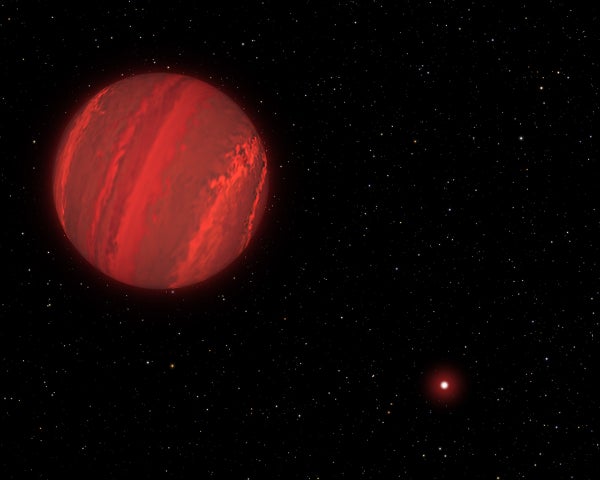
Luckily that heated youth makes this world glow in the infrared as it cools down. By monitoring this light the researchers have measured a regular variation in brightness of about a percent. This modulation is best modeled as a sinusoidal change, most easily explained by patchy and colorless clouds in the planet's atmosphere, scooting around in a 10.7 hour spin period.
It's a lovely observation that provides new insight to the climate regimes of gas giant worlds and their kin. The technique also serves as a pathfinder for future observatories like the James Webb Space Telescope, and offers clues to how we will continue to expand our understanding of other worlds - gas giants and perhaps smaller planets too.

Changes in the infrared brightness of a super-Jupiter as measured by the Hubble Space Telescope. The sinusoidal-like curve is extrapolated from the data points and suggests a 10-hour rotation period. Credit: NASA, ESA, Y. Zhou (University of Arizona), and P. Jeffries (STScI)