
This article was published in Scientific American’s former blog network and reflects the views of the author, not necessarily those of Scientific American
If all goes well NASA's Parker Solar Probe will launch soon (barring new delays) and begin its dive to the nearest star. By the end of 2018 it should have performed its first perihelion (closest) pass of the Sun, with a gradually tightening elliptical orbit that brings it out towards the orbit of Venus and back down for further perihelions that come as close as 6.16 million kilometers to the visible stellar surface.
With an initial mission lifetime of nearly 7 years the Parker probe should manage 24 of these swooping passages, protected by its 4.5 inch thick carbon-carbon composite heat shield. Since it will take signals from perihelion about 8 minutes to reach us, the spacecraft it is highly autonomous, coded for thermal self preservation at all costs.
I wrote a few years ago about the extraordinary velocities this mission will attain. This deep into the gravity well of a star you move fast. At its peak the spacecraft will hit up to 200 kilometers a second - nearly 0.07% of the speed of light.
On supporting science journalism
If you're enjoying this article, consider supporting our award-winning journalism by subscribing. By purchasing a subscription you are helping to ensure the future of impactful stories about the discoveries and ideas shaping our world today.
But the really remarkable stuff is what this probe should help tell us about the functioning of the Sun. In particular it will probe the still-mysterious mechanisms that heat the solar corona and propel a heady mix of particles out into interplanetary space. The supersonic solar wind (theorized by Eugene Parker in the 1950s) doesn't just directly affect the objects orbiting the Sun - from planets to comets - it reaches all the way out to the soup of interstellar medium and interstellar space. The solar wind is the hugely extended outer atmosphere of our star, and we all spend our lives within it. Only one other spacecraft, Voyager 1, has dipped its proverbial toe outside and into the great ocean between the stars.
The behavior of this atmosphere can reveal what's happening much closer to the Sun, right down to the roots of its corona and the twisty magnetic fields and turbulent streams of matter pouring off into the cosmos. The Parker probe will go in deep to get ground truth data.
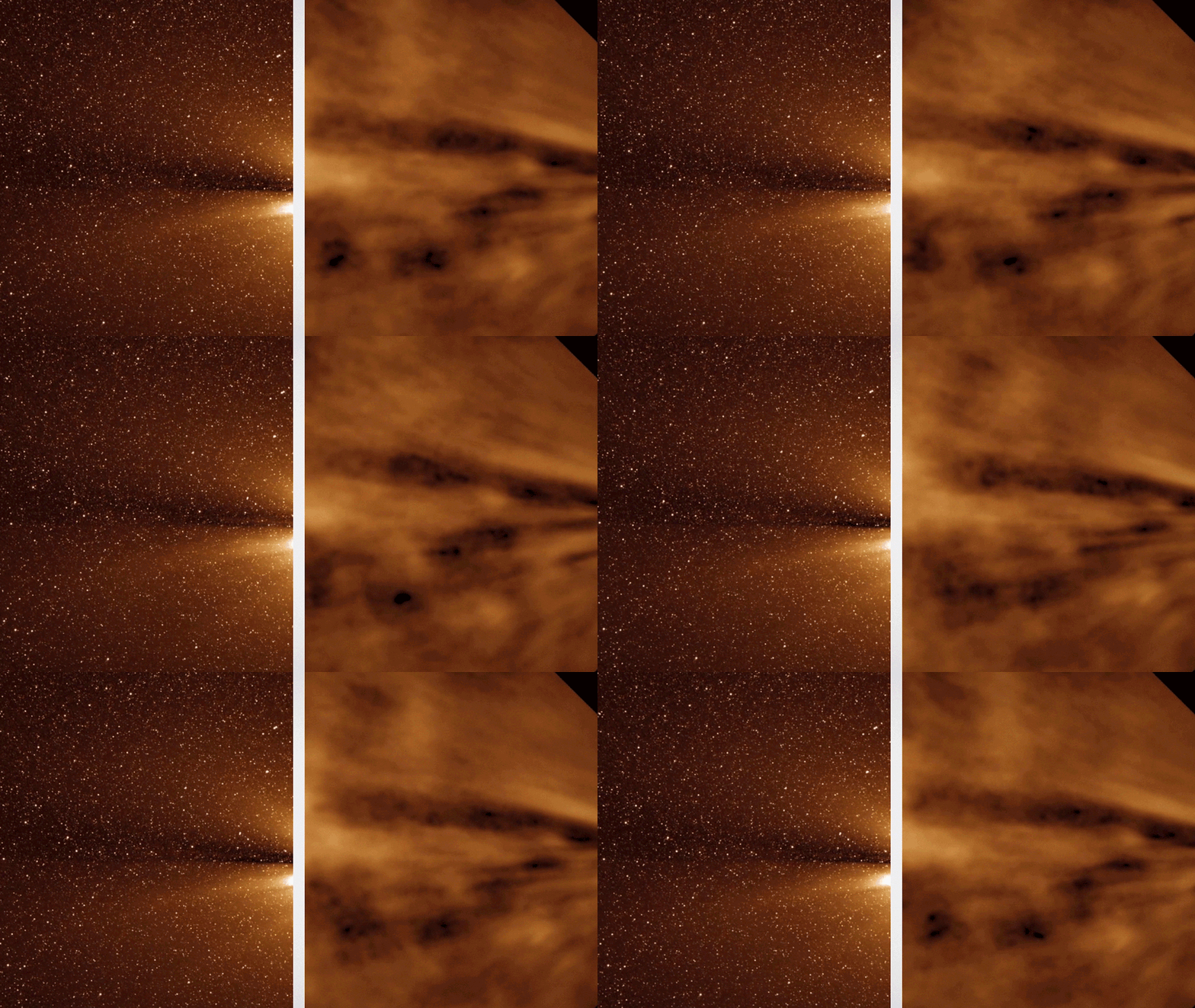
We have some idea of what the Parker probe will experience because we can see part of the solar wind as it scatters visible light. As a warm up (no pun intended) to this exciting solar descent, here is a wonderful animation of the solar wind seen in white light by NASA's STEREO mission - a pair of identical spacecraft that monitored the Sun from 2006 to 2016 (at which point one spacecraft dropped from contact). Images have been tweaked to account for the exposure time which tends to blur details, and background stars and dust have been carefully removed from the data (see further below for more of the before and after). The Sun is off towards the right of this looping timelapse movie.
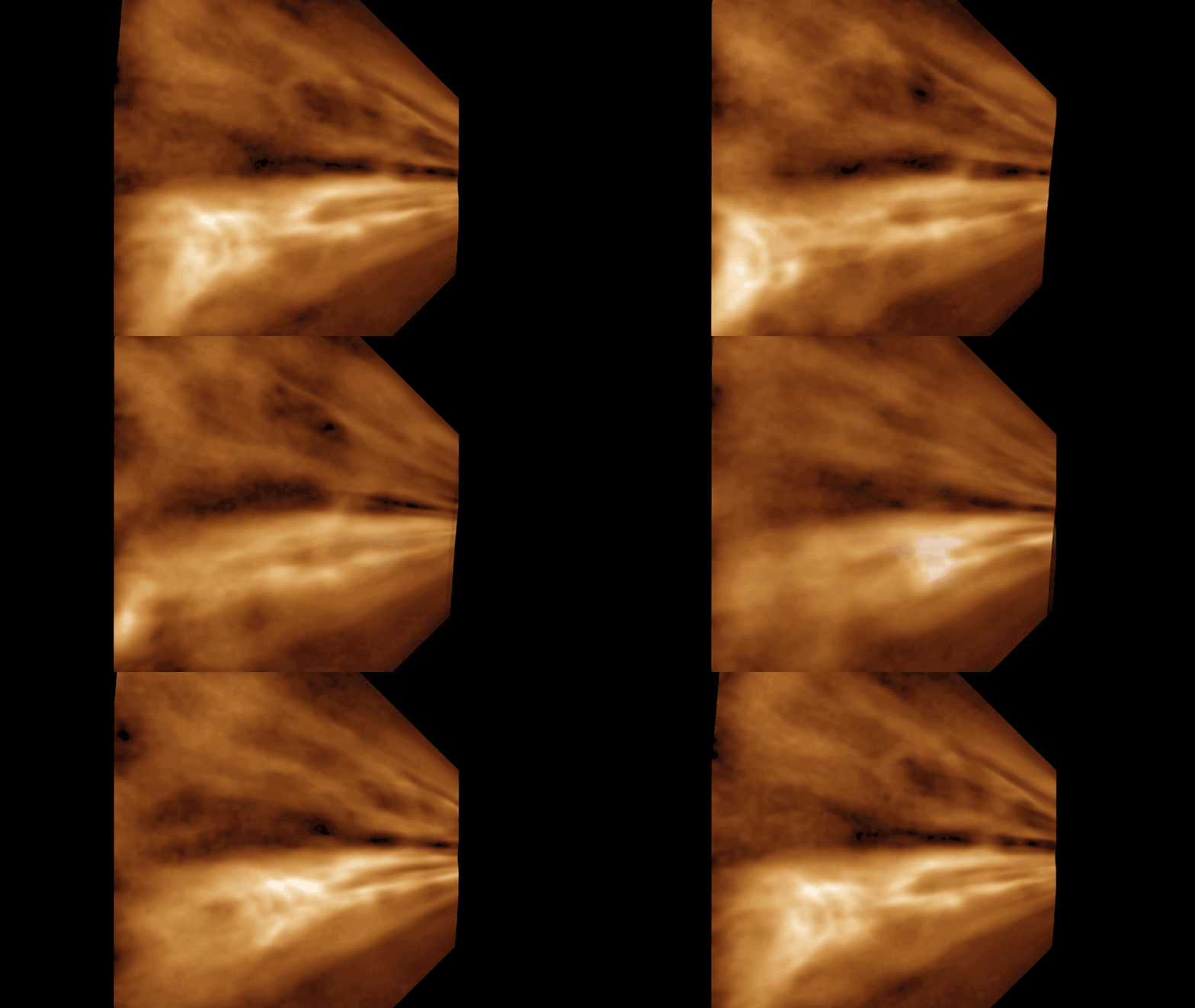
The solar wind blowing. Credit:NASA’s Goddard Space Flight Center, Craig DeForest, SwRI and work by NASA's Goddard Media Studios
You can see a little more of how the STEREO data has been cleaned up and assembled in the following panels - showing how the stars on the left panel (the 'as seen' data) are removed for the right panel and the frames enhanced.
With a little luck the Parker Solar Probe is going to get us closer to a star than ever before. We don't know all that it may reveal, but it should be a pretty wild ride.