
This article was published in Scientific American’s former blog network and reflects the views of the author, not necessarily those of Scientific American
Tau Ceti, a G-class star about seventy-eight percent the mass of our sun, and perhaps only a billion years older, has long been a favorite watering hole for science fiction. But for a variety of reasons it's perhaps received less attention from hungry exoplanetary scientists, astrobiologists, and wannabe interstellar explorers than it really deserves.
At a distance of 11.9 light years, the single Tau Ceti sun is about 2.8 times further away from us than Proxima Centauri b - the closest planet harboring star we know. Since 2012 there have been claims of astronomical detections of planets orbiting Tau Ceti, based on Doppler measurements of the stellar 'wobble'. More recently, data from the the HARPS spectrometer at the European Southern Observatory's La Silla site in Chile, combined with measurements from the HIRES instrument at the W. M. Keck Observatory in Hawaii have been analyzed to yield evidence for 4 roughly Earth-sized worlds orbiting Tau Ceti.

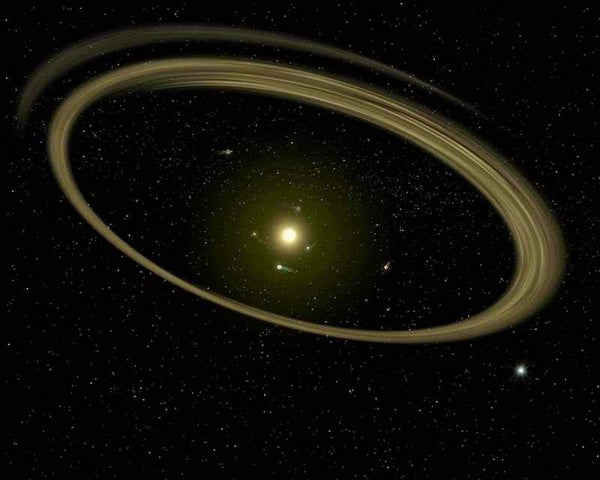
Putative Tau Ceti planets compared to the solar system. Credit: F. Feng University of Hertfordshire, United Kingdom
On supporting science journalism
If you're enjoying this article, consider supporting our award-winning journalism by subscribing. By purchasing a subscription you are helping to ensure the future of impactful stories about the discoveries and ideas shaping our world today.
These planetary candidates range in size from at least 1.7 times the mass of the Earth to perhaps 4 times more massive. But with orbital radii spanning 0.13 AU to 1.3 AU at least two of these worlds sit close to the boundaries of the nominal liquid-water orbital zone in the system.
It's a challenging analysis, pushing the limits of what the Doppler, or radial velocity technique can manage, and relies on some tricky noise removal to dig out delicate signals. Nonetheless, if future work confirms these worlds it helps elevate Tau Ceti to another 'must have' exoplanetary system.
Intriguingly, it's been known for a while that Tau Ceti is surrounded by a lot more interplanetary dust than our solar system (as much as tens time more). This material fills out a region spanning orbital distances from roughly 10 AU to 55 AU. This suggests that the system may have a more substantial analog to our Kuiper belt, and experiences a more vigorous rate of collisions and planetary impacts than our solar system.
Together with observations of other dusty, 'debris' disks around nearby stars it has been suggested that our solar system might be somewhat unusual in having a narrower 'belt' of outer material. Perhaps we're actually in an asteroid and comet poor system. The heavy element abundance of Tau Ceti is also about 28% that of the Sun.
All in all, Tau Ceti is a really intriguing place. It's not so far away, it looks like it has interesting planets, but it's also older, and different in some fundamental ways that could be important for the likelihood of any kind of life emerging or being sustained.
If interstellar probes, like those proposed by Breakthrough Starshot, are ever launched, it might be worth adding Tau Ceti to the target list. It could take 20 years to reach Proxima Centauri, and 60 years to get to Tau Ceti, but it could easily be worth it.