
This article was published in Scientific American’s former blog network and reflects the views of the author, not necessarily those of Scientific American
The nature of gravitational waves is, in and of itself, not so very hard to grasp. If you can make the jump to seeing spacetime as a 'something' you can make the jump to imagining that you can warp it and send ripples through it.
Of course the mathematical physics that describes spacetime's response to mass and energy, the theory of general relativity, is not for the faint of heart. It's beautiful, but it's also an intimidating display of partial differential equations and tensors mathematics.
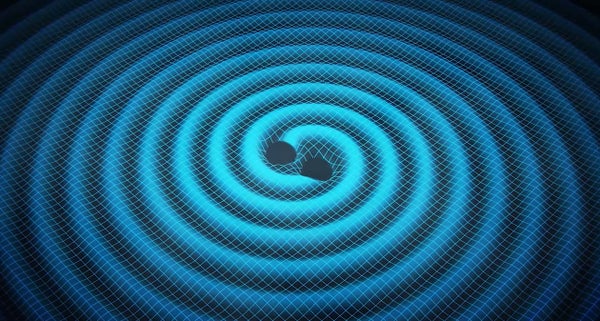
This is especially true when we try to describe the most extreme examples of mass, energy, and spacetime - black holes. But that's not all, because nature goes and plays a game of 'catch-me-if-you-can'. In the real universe we don't just have to worry about single black holes (which are tough enough to understand), but also binary black holes that will - in principle - spiral together and merge to make a single, larger, black hole. And they do this by pumping gravitational waves out into the cosmos.
On supporting science journalism
If you're enjoying this article, consider supporting our award-winning journalism by subscribing. By purchasing a subscription you are helping to ensure the future of impactful stories about the discoveries and ideas shaping our world today.
Calculating the details of exactly how that might happen is awfully hard for anything resembling a realistic situation (complete with asymmetries and non-circular orbits). In fact it wasn't really a solved problem until very recently - in the mid-2000's - and it took the heft of numerical physics and advanced computational techniques to finally crack it.
Part of the reason for the challenge is that in a system of merging black holes the very coordinate system that you're trying to work in is changing and is literally being swallowed through the event horizons of the holes. But it's also a consequence of the non-linear nature of Einstein's equations - which greatly complicates things. In more classical physics, such as electromagnetism, Maxwell's linear equations help us readily calculate how, for example, an electron might radiate away energy. But make that radiation of energy a non-linear property and the equations get a lot stickier to solve.
The following movie (Credit: Caltech/Cornell) gives some idea of the nature of the problem.
The bottom line is that theory and computation predict that a binary black hole system will spiral together, radiating away momentum via gravitational waves with increasingly short wavelength (increasing frequency). With a final high frequency, high amplitude 'chirp', the holes can merge inside a highly distorted event horizon that quickly 'rings down' to a more settled state - again by radiating away energy in gravitational waves. It is precisely this set of signatures that an experiment like A-LIGO can look for.
Depending on the geometry of the collision and the spin of the holes, a fraction of the total mass of the original two holes will be lost as gravitational wave energy. So you might start with two holes totaling 100 solar masses, and end up with a hole of perhaps 95 solar masses. That may not sound so impressive, but we're talking about solar masses - a few 1030 kilograms of mass turning into gravitational radiation and being lost to the cosmos in a very short time. In other words, these black hole mergers can briefly be among the most luminous objects in the universe - except their luminosity is not in electromagnetic radiation, but in gravitational radiation.
There's one other little trick up the sleeve of a merging black hole system. If the black holes are asymmetric (with different masses for example) something very peculiar happens. As the holes merge they experience a recoil, and can shoot off across the cosmos. Another way of looking at this is to say that the center of mass of the system - the 'balance point' between the masses - follows a spiral path outwards as the holes spiral inwards. At the end, the whole system - the 'new' black hole - is moving, or recoiling off in some direction.
Researchers have found that if you add in the spin of the black holes, that recoil velocity could be huge - reaching levels of 4,000 kilometers a second. That's enough to propel the newly formed hole out of any known galaxy, easily exceeding the escape velocity.
So is the cosmos strewn with high speed black hole merger products? Not necessarily, the final recoil velocity depends a lot on details of how the two holes' spin was aligned and the difference in mass of the holes - and can be a lot less. But the truth is we don't know the full story yet about any of this, and that's why the quest to detect gravitational waves is so exciting.