
This article was published in Scientific American’s former blog network and reflects the views of the author, not necessarily those of Scientific American
This week brings a video reconstructed from images of the Philae lander's approach to a comet, and a major new analysis of data from the Cassini mission that bolsters the case for a global, not just local, ocean beneath the icy crust of Enceladus.
When the European Space Agency's small lander Philae attempted to set down on the nucleus of comet 67P/C-G back in November 2014 it had a rough time, ultimately bouncing and ending up wedged in unfortunate circumstances on the surface.
But during its slow descent it did manage to send a series of 7 images from between 67 and 9 meters above the landing site. Now these images have been carefully assembled and interpolated to produce a video that simulates what Philae was actually experiencing during that time. You can watch it here.
On supporting science journalism
If you're enjoying this article, consider supporting our award-winning journalism by subscribing. By purchasing a subscription you are helping to ensure the future of impactful stories about the discoveries and ideas shaping our world today.
Perhaps the most striking aspect of this movie is just how cautious the approach was. From the range data it's apparent that Philae was drifting in at not much more than a meter a second - yet it bounced big time. A cometary nucleus this size has a truly pitiful gravitational field, which makes it very hard to hit and stick.
And for a different type of water rich object, the ice-shrouded Saturnian moon Enceladus, hundreds of millions of miles further away, comes the tour de force of a fascinating new analysis of seven years' worth of image data from NASA's Cassini mission.
By tagging distinct features on Enceladus's surface, such as craters, scientists have been able to build a quantitative picture of how this small moon wobbles as it orbits Saturn.
Like most astrophysical objects, Enceladus may look perfectly spherical, but it isn't really. As a consequence, while Enceladus moves through its slightly elliptical orbit, Saturn's gravitational field rocks the moon back and forth - or 'librates' it by tiny amounts.
The position of features in hundreds of Cassini images has allowed the researchers to track these librations. They've discovered that the back and forth wobbles of this moon (about 0.12 degrees in amplitude) are much larger than they should be if most of the interior were solid ice or rock.
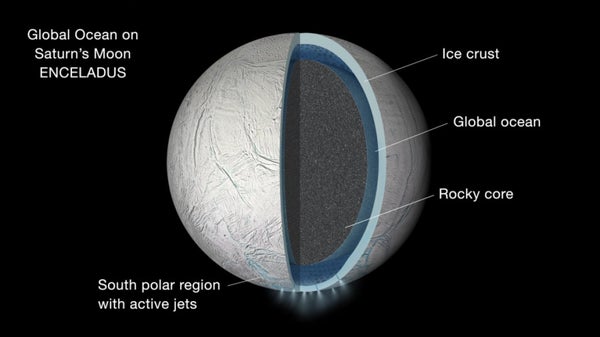
Good evidence already exists for some kind of liquid water 'pocket' towards Enceladus's south pole - where it regularly erupts with plumes of water ice and other compounds that suggest a deeper hydrothermal system - but the excess wobble of the whole moon now indicates that there is in fact a global ocean.
This body of liquid, likely composed of salt-rich water, helps disconnect the icy crust from the core of the moon, and allows for the big librations seen in the measurements. It could be some 30-40 kilometers in depth, starting perhaps 10 or 20 kilometers below the surface.

Our new best bet for the interior of Enceladus (Credit: NASA/JPL-Caltech)
It's a very exciting result, an extra feather in the cap for Enceladus as a prime target to search for life in the solar system. It also raises an intriguing puzzle as to how this ocean is kept warm.
In one of the mission's final flourishes, on October 28th, Cassini will make its closest ever flyby of the active icy plumes - plunging through their territory a mere 49 kilometers above the surface of Enceladus. We'll have to wait and see if this little moon has any more surprises in store for us from that encounter.