
This article was published in Scientific American’s former blog network and reflects the views of the author, not necessarily those of Scientific American
As data trickles back at kilobytes per second from NASA's New Horizons mission—now speeding deeper into poorly known interplanetary territory—more of Pluto's strange and fascinating surface features are revealing themselves.
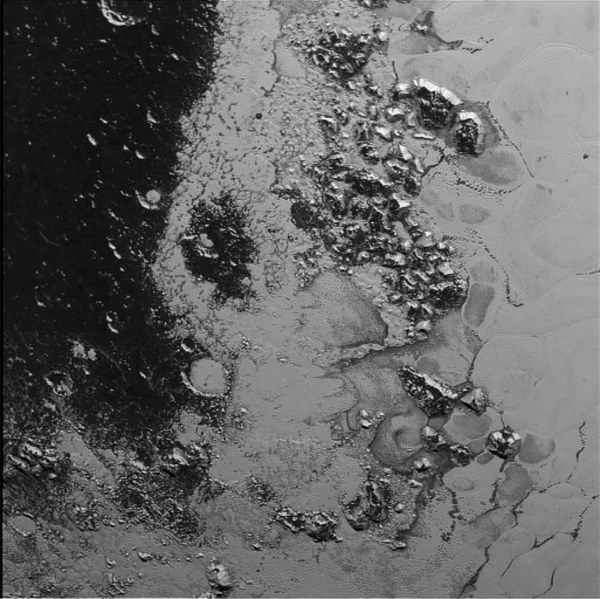
This latest image, taken at distance of 48,000 miles on July 14, shows a segment of Pluto from the lower left edge of the now famous 'heart' region, or Tombaugh Regio. Features as small as half a mile across are visible.

(Credit: NASA/JHUAPL/SWRI)Caption
On supporting science journalism
If you're enjoying this article, consider supporting our award-winning journalism by subscribing. By purchasing a subscription you are helping to ensure the future of impactful stories about the discoveries and ideas shaping our world today.
Here there are more of the odd-looking 'barnacle' mountains (my term, not an official label), thought to perhaps be protrusions of water-ice, which is rock-hard at Pluto's surface temperature of around minus 230 Celsius. This particular range rises perhaps between a half-mile and a mile above the flatter plains.
But perhaps the most sriking feature of this region is the transition between the lighter, more reflective, flat area to the right and the darker, more heavily cratered zone to the left. What, why and how are questions to which no one has a definitive answer at this time.

Zoom in on edge of light/dark regions. Note that some craters appear filled-in with light deposits, but not all - lowermost crater pair in particular - perhaps a sign of crater age? (Credit: NASA/JHUAPL/SWRI).
The lighter colored icy plains, extending up and across the center of Tombaugh regio are thought to be not much more than 100 million years old—based on the absence of cratering—making them positively youthful on planetary timescales. Is their formation a product of internal processes, or due to repeated cycles of sublimation and condensation of compounds like nitrogen, methane, carbon monoxide and more, as Pluto tracks through its 248 Earth-year orbital seasons? Perhaps the likeliest mechanism is some combination of all of the above.
Peering at the details it's also apparent than several of the craters to the left of this image are partly 'filled in' by the lighter material. The image at left zooms in on some of them.
The interesting thing is that there appears to be variation in the fill-in, perhaps a result of the process, or perhaps a sign of different crater ages. Have younger craters not yet got a layer of lighter ices deposited from a changing atmosphere?
At this point it's safe to say that Pluto has exceeded all expectations when it comes to surprises, and is likely to keep on serving up more of the same.