
This article was published in Scientific American’s former blog network and reflects the views of the author, not necessarily those of Scientific American
The puzzle of what kind of phenomenon life is has pursued us throughout history. From long defunct notions of ‘vital sparks’ and spontaneous generation all the way to our modern picture of Darwinian evolution and molecular biology. We still don’t have all the answers. It is really quite extraordinary that the very thing that we are – a complex mush of living systems – continues to elude our efforts to formulate a precise, singular, description and explanation.
One core observation though is that individual living things and collectives of living things tend to be self-stabilizing. In cells or in bodies we talk about homeostasis, a regulation of systems through a process of sensors, control, and effector feedback. Maybe some element of a biological system monitors temperature and controls another element that pumps out chemicals to drive physiological changes that help warm or cool an organism. Or another element senses acidity and governs an organism’s ability to lower or raise its internal pH to optimize its chemical functions. Homeostasis is all about maintaining a dynamic equilibrium.
This makes complete sense. It’s simple logic. If a system cannot do this it will fail and will no longer exist in the world or propagate itself or its offspring. But that also means that – as we know from the history of life on Earth – there will be lots and lots of variants and systems that don’t achieve homeostasis in the long run. It’s simply another, rather mechanical, way of looking at the process of selection in evolution.
On supporting science journalism
If you're enjoying this article, consider supporting our award-winning journalism by subscribing. By purchasing a subscription you are helping to ensure the future of impactful stories about the discoveries and ideas shaping our world today.
Homeostasis also offers an interesting perspective when it comes to looking at an entire planetary biosphere. Indeed, this is a key piece of the famous Gaia hypothesis originally formulated by James Lovelock in the 1960s. The idea that the whole terrestrial biosphere is a self-regulating system, whereby life makes Earth more suitable for life. Except for when it doesn’t.
In fact, Lovelock and others have over the years pointed out that there’s really nothing magical about the Gaia idea. If it gets perturbed enough, by humans for instance, the equilibrium can most certainly be broken and the whole system can shift to an unstable state. In other words, the idea that we look at the persistence of life on Earth (from what appears to be a common ancestor) as a sign that once life happens to a planet it’s hard to get rid of might be misleading.
To put this another way: we have little way to know whether the four-billion-year continuity of the terrestrial biosphere is typical or an outlier – the rule or the exception. If it hadn’t happened this way here, we’d not be around to make the observation.
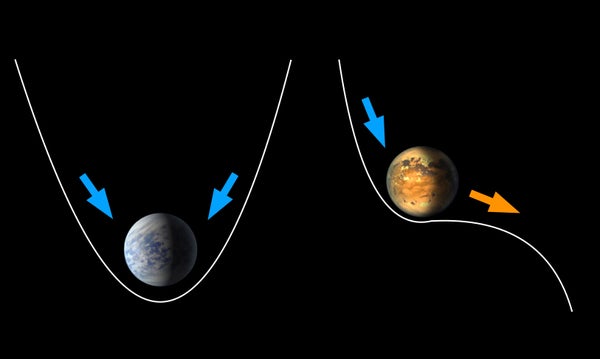
In fact, I think it’s interesting to ponder a rather contrarian viewpoint. What if planet-wide life more frequently winds up self-terminating than self-perpetuating? It could be that down at a cellular, or small-scale level life is indeed just as persistent as we might suspect. Once it gets going as an autocatalytic, selective, and evolvable phenomenon it works very well in a localized environment. But once it occupies an entire planet – a truly finite domain – the magic of homeostasis is much more hit or miss. It could be the case that when large-scale, planet-wide feedbacks due to life’s activities start to become significant there are more unstable than stable configurations. The little diagram at the top of this post, and below, represents the two options, with arrows indicating ‘forces’ of feedback. One nestles a biosphere into global homeostasis, the other is only stable in one direction, and falls off a rolling cliff in the other.
To say this slightly differently. There doesn’t seem to be any guarantee that life will always make a planet more suitable for life. It could actually do the opposite (and that statement doesn’t need to include things like a technological species destroying its own world, it could hold for simple microbes too). In fact, if life originates frequently but also self-terminates frequently, we might find that most of the universe is filled with very young biospheres (not necessarily only on young planets) teetering on the brink of instability.

Two scenarios: stability (left) and instability (right). Credit: C. Scharf 2020