
This article was published in Scientific American’s former blog network and reflects the views of the author, not necessarily those of Scientific American
Having already talked about Death on Mars, and Surviving Mars on these pages it seems reasonable to carry the discussion a little further. Especially given the extraordinary efforts being made by SpaceX to push forward the transport infrastructure for getting humans, lots of humans, to the red planet – as described in this eye-opening article by Eric Berger in Ars Technica.
Specifically, a pretty clear option for mitigating some of the hazards on Mars for humans is to get underground. As I have described previously, high energy cosmic rays can penetrate a few meters into Martian regolith, spraying secondary radiation into whoever is unfortunate enough to be there. In addition, the immediate surface environment is rich in nasty oxidizing chemicals, strong ultraviolet light, and occasionally pelted by small meteorites that fall intact because of Mars's thin atmosphere.
But do we really want to try to construct deeply buried and shielded habitats on a large scale? Far better to look for naturally occurring shelters.
On supporting science journalism
If you're enjoying this article, consider supporting our award-winning journalism by subscribing. By purchasing a subscription you are helping to ensure the future of impactful stories about the discoveries and ideas shaping our world today.
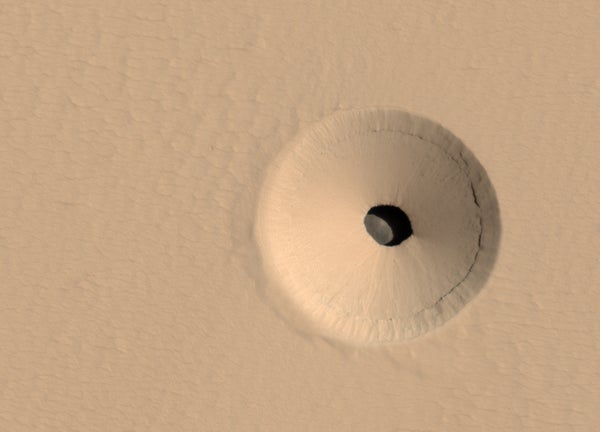
High resolution surface imaging data taken over the past couple of decades by instruments like the Mars Reconnaissance Orbiter Context Camera system (CTX), together with Mars Odyssey's thermal emission imaging system (THEMIS), have enabled scientists to search for signs of deep pits, caves, and lava tube structures on the planetary surface.
In general an opening to a deep enough cave will exhibit a combination of extreme shadowing and thermal characteristics that suggest a large interior volume. In practice the data, often with 6-meter per-pixel resolution, is challenging to interpret. Nonetheless, work had been underway over the years on a Mars Global Cave Candidate Catalog, or MGC3. Some of those results have been presented by Glen Cushing at the US Geological Survey.
The bottom line is that the very best region for cave candidates on Mars seems to be part of the spectacular Tharsis bulge. A region containing the three enormous shield volcanoes, Arsia Mons, Pavonis Mons, and Ascraeus Mons (with Olympus Mons actually sitting off a little away from this region). Across this terrain a total of 1,029 good cave candidates have been identified (see the figure below). Including 349 potential lava tube skylights (openings into these structures) in 27 tubes that span a total length of some 1,250 kilometers.
Of course, the data we have at the moment can't tell us the true extent of any caves, nor can it easily detect smaller or non-sky-facing entrances. But, rather remarkably, we do seem to know where on Mars we should be sending human explorers if they want to have the best shot at finding natural, essential, and permanent shelter.

Tharsis cave candidates from the MGC3 catalog. Credit: G. Cushing and USGS