
This article was published in Scientific American’s former blog network and reflects the views of the author, not necessarily those of Scientific American
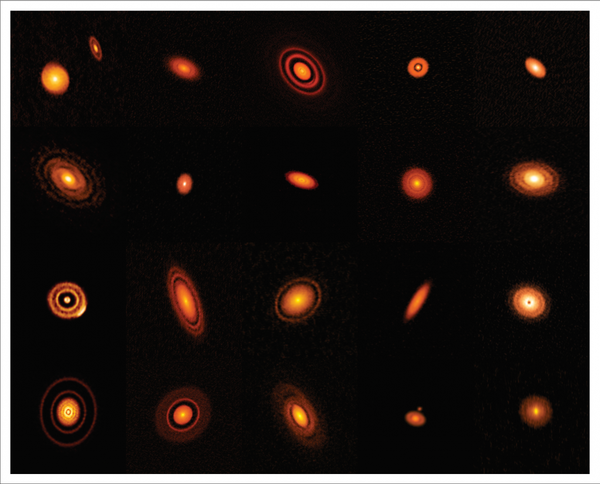
A series of remarkable astronomical images have been released by a team of scientists working on a project known as Disk Substructures at High Angular Resolution Project (DSHARP). This effort is one of the large scientific programs being undertaken using the Atacama Large Millimeter/submillimeter Array, or ALMA, positioned on the extraordinary Chajnantor plateau in the Chilean Andes - at an altitude of some 5,000 meters.
Sitting at this location puts the 66 high-precision antennae (dishes) of ALMA above and away from much of Earth's atmospheric water vapor. This creates an exceptionally transparent window from the surface of the Earth for looking at the long-wavelength (or terahertz) photons coming from a multitude of cosmic phenomena.
Some of those phenomena include the warmish dust surrounding young stars - part of the swirl of proto-planetary or circumstellar disk material that we know as vital to the formation of new planetary systems. Earlier images from ALMA - which really only started generating science data back in 2011 - have already included a couple of examples of these disks.
On supporting science journalism
If you're enjoying this article, consider supporting our award-winning journalism by subscribing. By purchasing a subscription you are helping to ensure the future of impactful stories about the discoveries and ideas shaping our world today.
But the DSHARP project has just given us an unprecedented overview, with 20 high resolution pictures of very young, still-forming star and planet systems spanning scales from a few astronomical units (AU) to about 100 AU. One of the standout features - immediately evident to our human eyes - is that these disks of dusty, proto-planetary material are being sculpted and carved by what must be forming worlds. Annular groove-like gaps and narrow rings suggest the agglomeration of material into dense planetary bodies that we don't see directly. Spirals and arcs in the density of the dust also points towards gravitational interactions between these disks and forming planets.
The abundance of these features helps confirm what we already see in our surveys of exoplanets - our galaxy is a planet-making machine.
But if we put aside the rich scientific treasures in these images for a moment there is something equally profound in the perspective they provide for us.
In this array of geometrically textured disks are entire solar systems emerging from a birth process of perhaps just a few millions of years. Each is an array of worlds, many likely containing rocky planets. Yet their history has only just begun. Which of these places, in a few billion years, might contain life? Perhaps some will eventually contain species that learn about their place in the universe, building their own means of peering out into the cosmos and in turn finding other planets, other youthful systems emerging into existence.
Four and a half billion years ago this was us. We were young worlds in among a disk of warm dust. Did other minds elsewhere look at us then? If they did, perhaps they too wondered what would become of this modest place in the billions of years to come, what organisms might emerge, what hopes, dreams and lives might play out in a future not yet witnessed.
