
This article was published in Scientific American’s former blog network and reflects the views of the author, not necessarily those of Scientific American
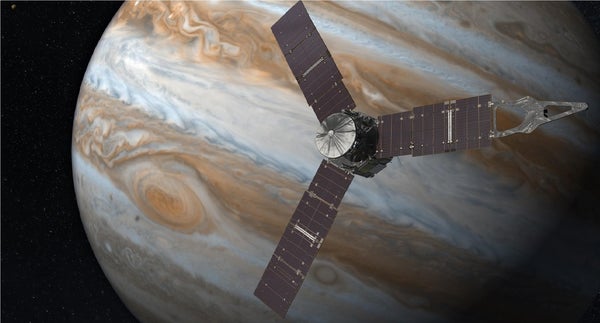
This July the 4th, 2016, NASA's Juno mission will finally arrive at Jupiter and fire its main engines for about 35 minutes to place itself (if all goes well) into an elliptical polar orbit around the gas giant planet.
Once there it's hoped that Juno can survive for about 20 months, during which time it will make at least 37 skimming passes over Jupiter's cloud tops - coming as close as just 4,700 km to the planet (2,900 miles). That's a record. Not counting the Galileo probe's death plunge, the nearest we've ever flown over Jupiter before was some 43,000 km (27,000 miles) out with the Pioneer 11 probe.
Juno will deploy a suite of scientific instruments to image and probe Jupiter and its atmosphere. With luck the mission will discover more about the extraordinary and vast internal terrain of this gas giant, including clues to its very origins.
On supporting science journalism
If you're enjoying this article, consider supporting our award-winning journalism by subscribing. By purchasing a subscription you are helping to ensure the future of impactful stories about the discoveries and ideas shaping our world today.
But visiting a giant world comes with a host of unique problems. For one, Jupiter is 317 times the mass of the Earth, and orbital insertion in such a deep gravity well is no mean feat. As I've written about previously in these pages, during its July 4th maneuvering Juno will have the distinction of hitting a velocity of some 160,000 miles per hour relative to Jupiter. That will be a temporary speed record for space exploration until NASA's Solar Probe Plus gets into close orbit of our own star sometime after 2018.
The other major challenge is the intense particle radiation that exists around Jupiter. With its powerful magnetic field (over 10 times the raw strength of the Earth's) the huge planet whips up an extremely damaging environment of accelerated electrons and ions.
It's estimated that Juno will experience a total radiation dose equivalent to roughly 100 million dental X-rays over its primary mission lifetime, or five million a month. That's bad news for the critical electronics on the spacecraft, where particle radiation can not only disrupt regular functions but will, over time, permanently wreck their molecular structure.
So how do you get up close to Jupiter without being quickly crippled?
To buy Juno more time the spacecraft design not only incorporates the best radiation-hardened processor (the rather alarmingly named RAD750 flight chip) but a first-of-its-kind titanium vault to shield the electronics. This 400 pound box (over 170 kilos) is made of 1 centimeter thick titanium and will reduce the total particle radiation by roughly a factor of 800.

Here comes the Juno vault (Credit: NASA/JPL, Source page here)
This is a major, but necessary investment in terms of spacecraft mass. Even this vault won't help forever though. As the highest energy relativistic electrons whack into the titanium they will release sprays of secondary particles that will reach all the way inside to eventually knock out Juno's vital organs.
With a little luck, well before that happens, Juno will have provided us with a new vision of another great vault - the still mysterious depths of the King planet of our solar system.