
This article was published in Scientific American’s former blog network and reflects the views of the author, not necessarily those of Scientific American
NASA's Mars Atmosphere and Volatile EvolutioN (MAVEN) mission doesn't always get a lot of press, but it's doing some pretty fancy science out at the red planet.
One of the instruments onboard this orbiting platform is the Imaging Ultraviolet Spectrograph (IUVS). This device takes pictures in a range of electromagnetic wavelengths from 110 to 340 nanometers - pretty much covering the parts of the ultraviolet spectrum we call UVC, UVB, and UVA. With wavelength (color) resolution as small as 0.5 nanometers, the IUVS can pry apart phenomena in the martian environment that reflect, scatter, absorb, or emit UV light.
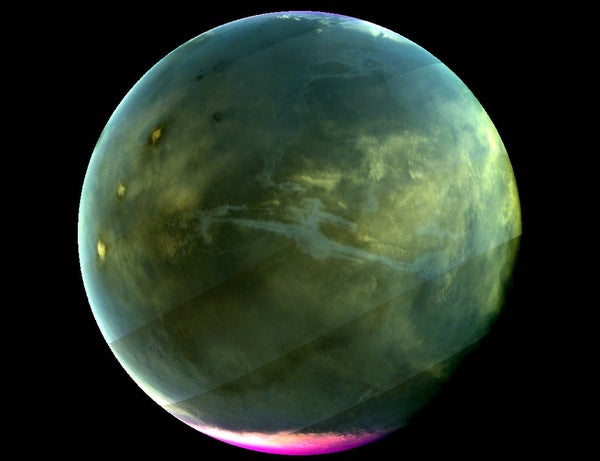
The image above is a good example. Here the UV light is shown in false colors so that our puny human eyes can makes sense of the data. The green hue of Mars indicates the reflections of UV light from the surface and some amount of atmospheric scattering. The gash-like, light blue feature across the center is due to very strong UV scattering by atmosphere sitting inside the enormous Valles Marineris canyon. Over on the left are bright cloud features surrounding the great Tharsis volcanoes.
On supporting science journalism
If you're enjoying this article, consider supporting our award-winning journalism by subscribing. By purchasing a subscription you are helping to ensure the future of impactful stories about the discoveries and ideas shaping our world today.
Perhaps the most striking feature though is the magenta 'glow' at the south pole. This is due to the absorption of UV by ozone. Unlike the Earth, atmospheric ozone can accumulate in the polar winter on Mars.

UV light absorbed by ozone (magenta) at Mars's southern pole. Credit: NASA, MAVEN and University of Colorado
Ultraviolet data is a rich probe of a host of planetary properties. High altitude cloud formation and flow shows up in the UV - especially around the giant volcanic peaks. Above these colossal features the afternoons appear to be the time for cloud accumulation. This time-lapse movie spans about 7 hours and captures the remarkable phenomenon - seen around the bright patches.
Credit: NASA, MAVEN and University of Colorado
Seeing where and when clouds form provides insight to the hydrological (water) cycle of Mars - and critical clues to the ways in which its climate system functions.
But it's also nighttime when interesting things happen in Mars's atmosphere. MAVEN has spotted UV 'night glow' coming from the chemical collision of oxygen and nitrogen atoms to form nitric oxide (NO). The oxygen and nitrogen are formed by photo-dissociation during the day, and linger long enough to combine at night.

Night glow (showing in green) in the UV, inset shows viewing geometry. Credit: NASA, MAVEN, and University of Colorado
The patchy nature of the UV nightglow indicates that high altitude winds and circulations in the martian atmosphere are complex and irregular.
Mars may always end up being the Red Planet, but for the moment we can call it the Ultraviolet Planet.