
This article was published in Scientific American’s former blog network and reflects the views of the author, not necessarily those of Scientific American
The announcement of a newly confirmed exoplanet in Kepler data orbiting within its star's 'habitable zone' is great news, but also reinforces some misconceptions about what an Earth-like world means.
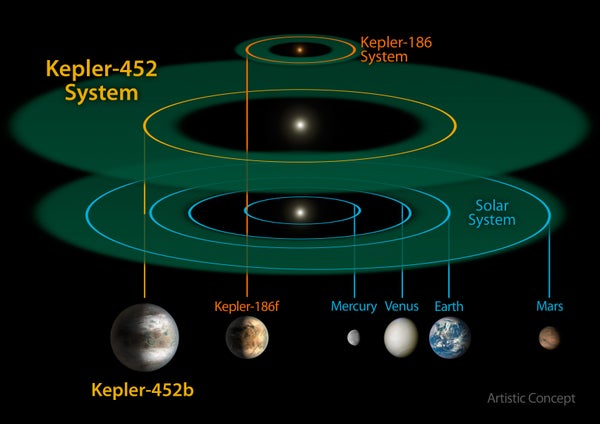
The NASA press release headline is "NASA’s Kepler Mission Discovers Bigger, Older Cousin to Earth", and this description is spot on. The planet in question, Kepler-452b, is 60% larger in diameter than the Earth and orbits a star some 1,400 light years from us that is just 4% more massive than our Sun, about 1.5 billion years older, and about 20% more luminous.
Critically this world's year is also 385 Earth-days in length, indicating that it likely spends its time at a distance from its parent star where the possibility exists for liquid water to occur on the planetary surface - depending a very lengthy list of other necessary, and essentially unknown, conditions.
On supporting science journalism
If you're enjoying this article, consider supporting our award-winning journalism by subscribing. By purchasing a subscription you are helping to ensure the future of impactful stories about the discoveries and ideas shaping our world today.
And here's where things get tricky, and where other headlines like "Earth 2.0", or "Closest Earth Twin", are wildly off-target.
It's a perrenial bugbear of mine, as you can tell from this earlier piece in 2012 where I bemoan the overuse of the term 'Earth-like'.
Here's why.
Kepler-452b has a physical diameter 60% larger than Earth, but owing to the distance of its system (those 1,400 long light years), we can't yet acquire the necessary astronomical data (high-precision spectroscopic Doppler data) to estimate the planet's mass and composition. This world might be significantly less massive than the Earth, but with a high water abundance (or conceivably a thick hydrogen atmosphere), or much more massive (even 10 times more if it has a high iron content).
We also don't know the shape of the orbit - it could be quite elliptical, altering the nature of energy input from the parent star and therefore the planetary climate. We have no idea what its rotation rate is - its day-length - or its axial tilt, critical ingredients for understanding thermodynamic conditions. We don't know what, if any, atmosphere the planet harbors, a key ingredient for deducing its surface conditions, and the true likelihood of liquid surface water.
We don't know whether or not it has any moons, or what the architecture is of the rest of Kepler-452b's planetary system. Does it have sister worlds? Does it get pummeled by asteroids?
Even if this world duplicates many of the Earth's properties, other astronomers have already pointed out that, at 1.5 billion years further along in its history, with a 20% more luminous star, Kepler-452b could conceivably be in the throes of habitable decline as a super-greenhouse, water-vapor-driven effect takes hold.
So the bottom line is that it is indeed a bigger, older cousin to the Earth. But it's impossible, and misleading, to equate this with Earth 2.0 or an Earth-like planet. The real conversation about worlds like these is much more interesting and complex.
I wish I knew how to get people to stop throwing terms like Earth-like around willy-nilly. The best I can propose is the following.
Earth-like should be reserved for exoplanets that you'd be willing to send yourself and your loved ones to, by packing everything up in a generational, one shot, interstellar slow boat that bankrupts the human species in the process. In other words, you'd better be 99.99% confident that upon arrival in 10,000 years there will be a nice tropical beach somewhere to set up shop. Anything less than that does not deserve the monkier Earth-like.
Finally, and a little more seriously, the focus on Kepler-452b distracts from what is perhaps an equally impressive result - the addition of 521 new candidate planet detections in the Kepler catalog. This lifts the tally of probable worlds spotted by the mission to a stunning 4,696, summarized in this graph:
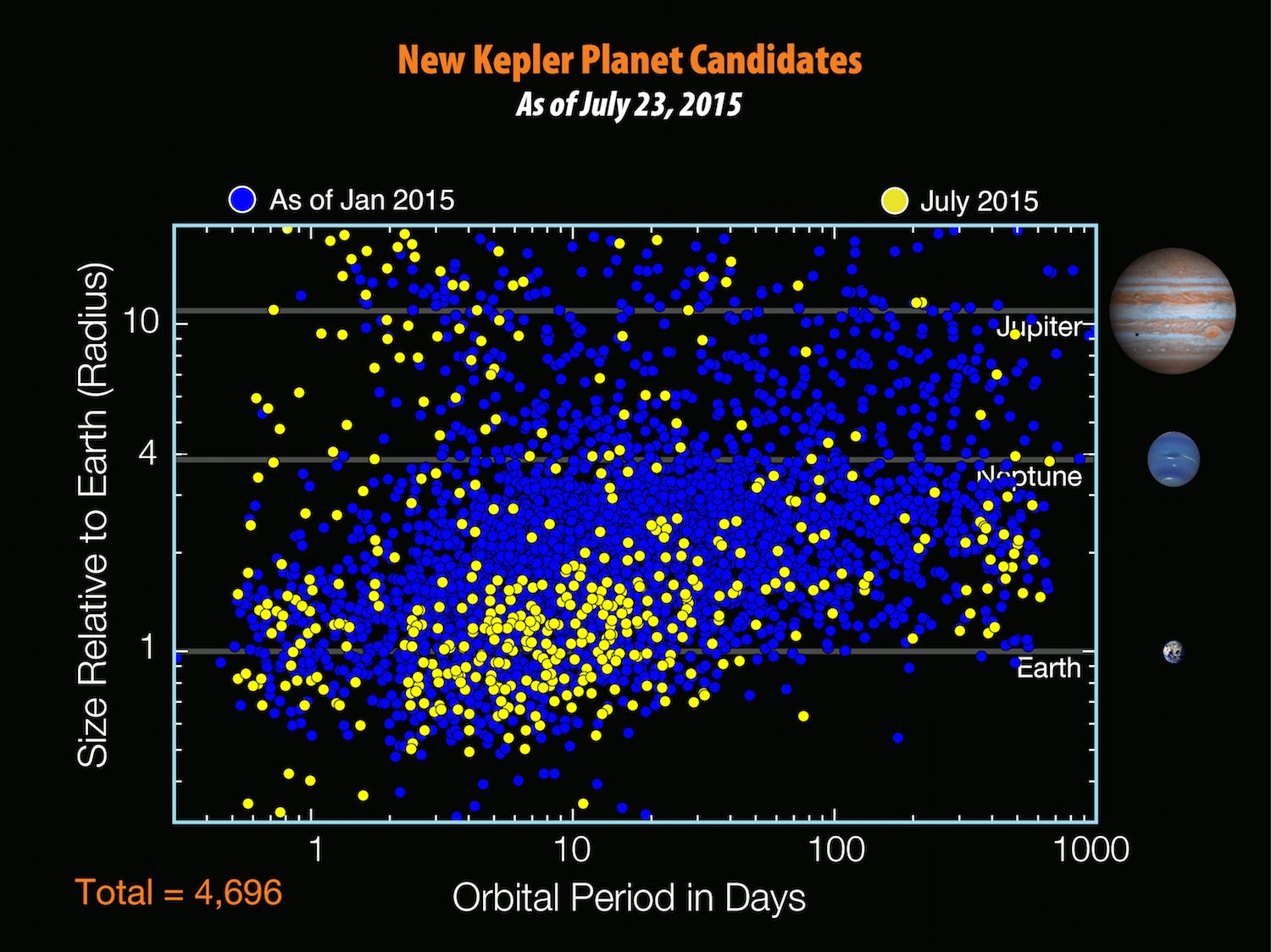
The latest Kepler tally (Credit: NASA/Kepler/W. Stenzel)Caption
Critically, 12 of the new candidates are between 1 and 2 times the diameter of the Earth and apparently in the nominal habitable zone of stars similar to the Sun in size and temperature. The statistical constraints on our planetary cousins are indeed getting better and better.