
This article was published in Scientific American’s former blog network and reflects the views of the author, not necessarily those of Scientific American
As summer approaches and wildfire season kicks into high gear, we can once again expect a series of heart-wrenching tales about injured animals fleeing from the flames. Accounts of endangered species threatened by these disasters and descriptions of koalas with burned paws tug at our collective heartstrings. But such articles tend to miss the big picture: Fires represent an ecological trade-off. While some species are threatened, others benefit.
In fact, closer analysis of the scientific literature reveals that koala mortality tends to be highly localized, and resource depletion from intense wildfires only poses short-term effects for koalas: populations will recolonize burned areas a few months after a fire.
In my work as a fire ecologist who studies the effects of fire on animal populations and community structure, one of the most common questions I am asked is about the risks that such fires pose to wild animals. It is important to remember that for many species, fires aren’t necessarily harmful and, in many cases they may be the key to preserving and restoring habitat. Many animals have evolved techniques to avoid, survive and even thrive on fire-prone areas.
On supporting science journalism
If you're enjoying this article, consider supporting our award-winning journalism by subscribing. By purchasing a subscription you are helping to ensure the future of impactful stories about the discoveries and ideas shaping our world today.
Additionally, fires have existed on our landscape for millennia, and these animal species have adapted in the presence of periodic fires. It is only recently, in the face of a multitude of human activities (e.g., deforestation, urbanization, development, increasing carbon emissions, fire suppression) that some species became endangered and that fires became an imminent threat.
In fact, in many ecosystems, our aggressive suppression of fire degrades habitat and threatens species more than allowing fires to burn; considerations about economics and livelihood obviously are a key part of this decision, but many fires occur in relatively remote areas and are not imminent human threats. Ultimately, your views on wildfire may largely be determined by which animal species you value most
And for some species, fires are essential. Saproxylic insects rely on fires to create the best habitat for nest sites. One such deadwood specialist, Melanophila acuminata (known as the fire beetle), has evolved chemical receptors to sense smoke on its antennae and thermal receptors under its wings to detect heat. These adaptations increase its competitive advantage over other early postfire colonizers.
For the federally endangered American burying beetle (Nicrophorus americanus), fires create the open savanna habitat that it needs to thrive and reproduce. Likewise, the red-cockaded woodpecker and Delmarva fox squirrel both require habitats that are maintained by periodic fires. Large herbivores such a bison maximize their time in recently burned areas, because the regrowing vegetation has a higher nutritional content and increased palatability. Pollinating insects benefit from increased flowering plant growth postfire. These examples are only a few of the many ways in which fires directly benefit wildlife populations.
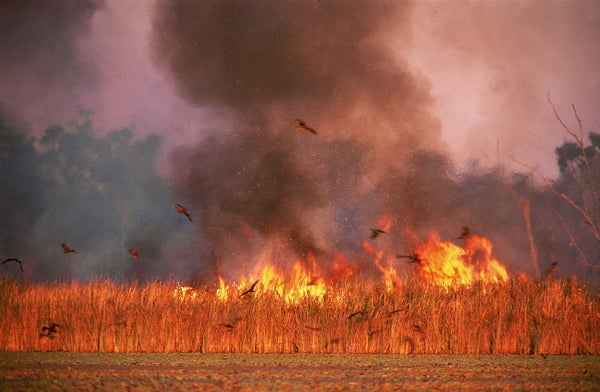
Perhaps the best case for the importance of fires to wildlife is recent evidence that some animals intentionally spread them. Research by geographer Mark Bonta, then at Pennsylvania State University, and his colleagues documents fire spreading by three species of raptors in Australian savannas. Collectively called the firehawks, these birds have long been known to the indigenous communities in the areas where they occur. The firehawks transport burning sticks in their talons and beaks to unburned areas to ignite fires there. As a result, small mammals and insects fleeing the fires become accessible prey for the birds.
These birds are distributed on three continents, and there are limited accounts of other species (including the crested caracara in the southern U.S.) that exhibit similar behaviors. The potentially widespread occurrence of this behavior led Bonta and his colleague to speculate that “humanity’s acquisition and manipulation of fire may be a result of the observation of intentional avian pyrophilic behaviour rather than solely from some relationship with lightning-caused fire”.
Most animals are likely to be just fine this fire season, and some will probably welcome the flames. But with rapidly changing fire regimes, in part because of climate change—namely, increases in the length of the fire season and in fire frequency, acreage burned and overall fire intensity—the future impacts on wildlife should be closely monitored.