
This article was published in Scientific American’s former blog network and reflects the views of the author, not necessarily those of Scientific American
Recently, I became aware of the extraordinary work of Shoshannah White, a photographer based in Roswell, New Mexico—specifically, her images of the Arctic. This is not documentary photography; it’s interpretive, moody work that reflects her own reactions to the impact of climate change on this vulnerable region.
Rather than attempt to characterize it myself, I think it’s more helpful for you to read her own statement about it before you proceed to view the slideshow. I think you’ll be moved, as I have been, by what she’s done.
Artist's Statement
On supporting science journalism
If you're enjoying this article, consider supporting our award-winning journalism by subscribing. By purchasing a subscription you are helping to ensure the future of impactful stories about the discoveries and ideas shaping our world today.
Formally, my practice is photography-based yet spans multiple media including painting, sculpture and public art installation. With content related to both visible and hidden information, the work here draws from experiences in Arctic landscapes and coal mining towns.
With a long-time interest in unseen worlds, I was originally drawn to the Arctic as a place so impacted by humans but with very little visual evidence. I was able to spend time in Svalbard, a Norwegian archipelago within the Arctic Circle and became fascinated with the landscape, the glaciers and also the history of coal mining. I was interested not only in the extreme beauty of the towering glaciers and the coal-packed mountains but also the hidden information held within the dense and layered makeup of the raw materials of this environment.
Later, I was able to collect glacier ice on-site in Alaska and coal from active and inactive mines in Pennsylvania and began creating photograms (cameraless, analog prints) from these raw materials. By placing the coal and ice in direct contact with light sensitive photographic paper, the process exposes hidden information and familiar patterning not visible to the naked eye. With this work, pairing Arctic landscape photographs with the abstract black and white cameraless prints, the work considers the environmental relationship between these materials and also the geologic parallels: both are formed through compression over time and each hold our shared planetary history in very different ways.
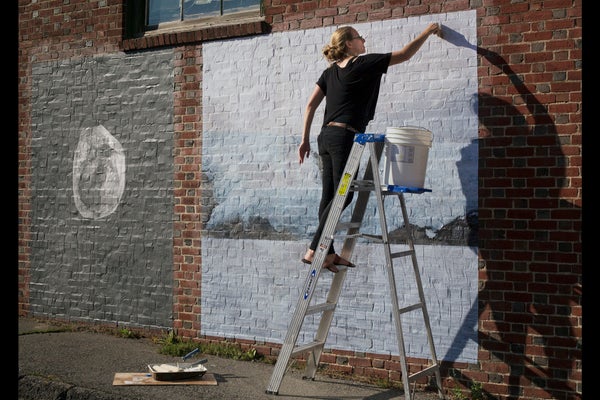
While the content relates to the environment, the work is very much about our psychological connection/disconnection with the world around us. As a photographer working in multiple media, these images exist in many forms from original framed prints and mixed-media works to multi-part installations as well as an ongoing exterior mural project.
