
This article was published in Scientific American’s former blog network and reflects the views of the author, not necessarily those of Scientific American
It makes me queasy to think of the obscenity of wiping out an entire ecosystem just because we insist on burning fossil fuels. Overfishing, pollution and habitat damage have made a mess of many coral reefs, but it is climate change that is doing them in globally. Coral reefs may essentially be gone in the next 30 years. Tears of frustration come easily, knowing it didn’t have to be this way.
As a marine biologist who spent a decade studying reefs, that breaks my heart, for I know intimately their majesty and intricacies. As a member of the human family, it makes me furious, because I know the food security and livelihoods of hundreds of millions of people hang in the balance. What the fossil fuel industry has done to this planet, knowingly, is a word far worse than vile.
The United Nations’ Intergovernmental Panel on Climate Change (IPCC) projects that if the average global temperature goes up 1.5 degrees Celsius above the preindustrial average, up to 90 percent of coral reefs will be wiped out. If the average temperature rises 2 degrees C, 99 percent will be gone. And the earth’s temperature has already increased 1.1 degrees C so far. Coral reefs just can’t take this heat.
On supporting science journalism
If you're enjoying this article, consider supporting our award-winning journalism by subscribing. By purchasing a subscription you are helping to ensure the future of impactful stories about the discoveries and ideas shaping our world today.
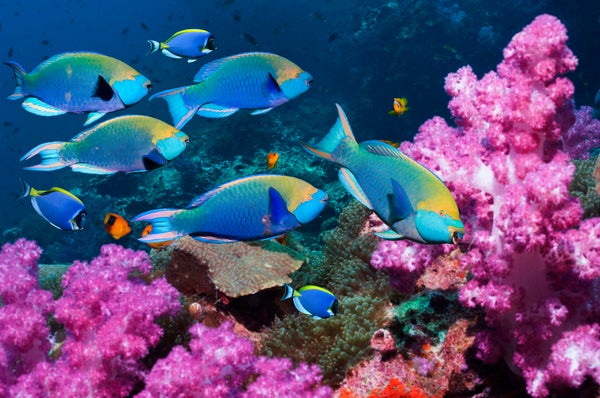
I saw my first coral reef in 1985, in Key West, Florida. I was five years old. And those overfished, polluted reefs were already only a glimmer of their former glory. But, through the floor of a glass-bottomed boat, they captivated me. When I later learned about the flamboyantly colored parrotfish—their abilities to change sexes, to secrete mucus bubbles to sleep inside, and to eat algae and coral and poop it out as fine white sand—my respect for this tropical web of life deepened. Parrotfish are my favorite fish. They have so much to teach us.
So I wrote and spoke this ode to parrotfish, confessing my love, sharing my heartache for the coral reef crisis, and reminding myself—and you—that despite the odds, we can’t turn away. While it is naive to think we can “solve” or “stop” climate change, it is also naive to give up, when every tenth of a degree of warming, every centimeter of sea level rise, every species we save, and every increasingly unnatural disaster we avert all matter so very much.
Video credit: TED