
This article was published in Scientific American’s former blog network and reflects the views of the author, not necessarily those of Scientific American
Last August, shortly after India revoked the autonomous status of the disputed Kashmir valley, the British medical journal The Lancetpublished an editorial expressing concern about the physical and mental health of Kashmiris. Pointing to “gross human rights violations by state security forces and armed groups,” in the region—often described as the world’s most militarized zone—it lamented the suffering of civilians caught between militants and tens of thousands of Indian troops. Human Rights Watch estimates that more than 50,000 people have been killed there since 1989. The “people of Kashmir need healing from the deep wounds of this decades-old conflict, not subjugation to further violence and alienation,” the editors concluded.
The essay provoked an immediate and furious backlash. The Indian Medical Association accused the Lancet of committing “a breach of propriety in commenting on this political issue” and accused it of “malafide intention.” The British Association of Physicians of Indian Origin demanded that the editorial board “retract the article and publish a public apology,” while the Indian Psychiatric Society condemned “this unsolicited intrusion into the affairs of the Sovereign Republic of India.”
And this is just a sampling of the more moderate responses. The Lancet stood by the editorial, however, and perhaps coincidentally, the British Medical Journal published a letter from 18 Indian doctors observing that the communications blockade imposed by the Indian government had led to “a blatant denial of the right to health care and the right to life” in the Kashmir valley.
On supporting science journalism
If you're enjoying this article, consider supporting our award-winning journalism by subscribing. By purchasing a subscription you are helping to ensure the future of impactful stories about the discoveries and ideas shaping our world today.
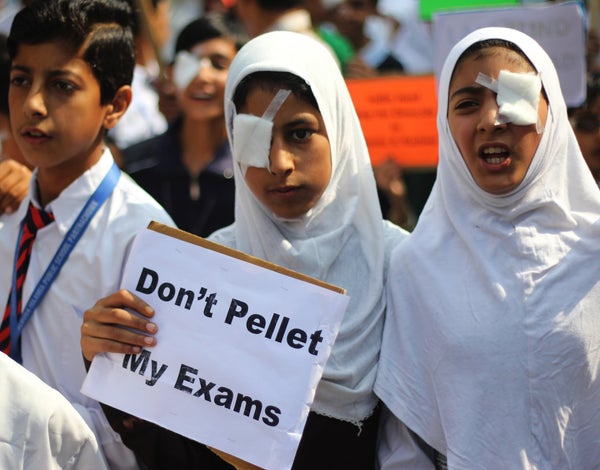
An American optometrist of Kashmiri origin, I was plunged into the conflict in 2016 when I arrived in Srinagar, the region’s capital, for a family vacation. Thousands of people were on the streets demanding freedom from Indian rule, and security forces were responding to stone-throwing youths by firing so-called pellet guns.
Often used for hunting wildlife and pest control in the West, these supposedly non-lethal weapons are in fact a type of shotgun. Each cartridge releases between 300 to 600 lead-based pellets, each of which can easily penetrate soft tissues and damage internal organs.When used at close range, the tissue damage is similar that of a bullet from a low-velocity conventional firearm and can result in permanent disability or death.
.jpg?w=1350)
X-ray of a pellet gun victim. Credit: Naureen M. Haroon
I visited hospitals to understand what was going on. I saw patients with more than 100 pellets in their abdomen or skull. A fourteen-year-old girl who was looking out of her bedroom window became unrecognizable within seconds due to hundreds of pellets covering her entire face and penetrating her skull. A 24-year-old’s left eyeball fell out of his eye socket.
India’s Central Reserve Police Force would eventually admit to using over 1.3 million pellets in just the first thirty-two days of those summer protests. This indiscriminate use of supposedly non-lethal weapons resulted in over ninety deaths and 15,000 injuries that summer. Over 500 of these wounds resulted in vision loss in one or both eyes.
This harrowing exposure prompted me to aid the U.S. based non-profit, Revive Kashmir, in starting Project Noor, which aids those visually impaired by pellet guns. My team members and I began with basic training for day-to-day survival in 2017. We taught patients how to eat, use their phone, and walk with assistance. Hearing the patient’s stories convinced me, however, that we needed to do more.
Teenagers, many of them villagers, had been robbed of the careers to which they aspired and instead felt like a financial and emotional burden on their already struggling families. Those who were studying had had to drop out of school and none of those working could continue. Eventually, Project Noor expanded to provide not only eye care and rehabilitation services, but also counseling and financial help to pellet-gun injured victims in the Kashmir valley.
In the years since, the number of deaths, injuries and blindness of innocent civilians, mostly children and young adults, has steadily increased. The Lancet editorial noted that 1253 people had been blinded by pellet guns between 2016 and 2018. The damage has been compounded by a lack of resources for the visually impaired. The traumatic injuries and deaths have also caused lasting psychological harm and left many victims depressed and suicidal.
Various other international and national non-profit organizations have come forward to aid patients with pellet injuries with surgical costs, medications and financial support. But all of these efforts have been put to a halt by the state of siege imposed on the eight million Kashmiris. For more than three months, a complete lock-down of the region, an increase in armed forces in an already heavily militarized zone, and suspension of telephone and internet use has prevented any aid from reaching the people.
Despite the communications shutdown, it is clear that human rights violations and pellet-gun injuries continue to happen. Medical supplies have become scarce, hospitals are difficult to reach because of barricades across the main roads, and the administration has reportedly stopped issuing death certificates. In consequence, we may not ever know how many Kashmiris are dying.
Given this harrowing reality, I am profoundly saddened that so many of my colleagues in the medical profession have chosen to ignore their Hippocratic oath and instead defend a regime that inflicts such grievous harm on civilians. When will this regime and its supporters stop turning a blind eye to the unnecessary human tragedy in Kashmir?