
This article was published in Scientific American’s former blog network and reflects the views of the author, not necessarily those of Scientific American
Ever since 2005, when NASA’s Cassini orbiter found plumes of water vapor spilling out of cracks in the south pole of Saturn’s icy moon Enceladus, researchers have sought to learn more about the moon’s mysterious interior as a possible abode for extraterrestrial life.
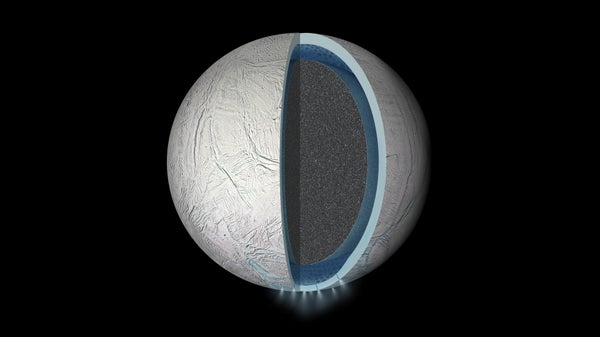
Repeated flybys of Enceladus have revealed wonders, including organic molecules and salts in the vaporous plumes that hint at hydrothermal activity deep within the moon, beneath what must be a sizeable reservoir of water.
Despite these discoveries, researchers have struggled to determine the dimensions of Enceladus’s watery depths. Careful measurements of the moon’s gravitational field yielded mixed results: Some theorists concluded there was just a small lens-shaped sea beneath the south pole, a wisp of moisture momentarily wrung from the ice by the tugs of nearby Saturn. In this process, called tidal heating, the gravitational pull of Saturn makes the crust flex, generating friction that warms the interior. On geological timescales, such a sea would be a transient thing, thawing and freezing in cycles that could preclude the emergence of biology.
On supporting science journalism
If you're enjoying this article, consider supporting our award-winning journalism by subscribing. By purchasing a subscription you are helping to ensure the future of impactful stories about the discoveries and ideas shaping our world today.
Other theorists argued instead that the Cassini data suggested a moon-spanning ocean. Though more amenable to life, such an ocean would be much harder to explain: Enceladus is a diminutive moon, only about as wide as Arizona, without enough mass to easily produce or maintain the large amounts of inner heat required for such a huge expanse of liquid water.
Now, new data from Cassini have provided the best evidence yet that Enceladus has a long-lived global ocean, not a small, short-lived sea. Rather than rely on more studies of Enceladus’s gravitational field, researchers relied upon seven years of images of Enceladus’s surface to measure the moon’s libration—how it wobbles as it orbits and rotates around Saturn. Though slight, the moon’s wobble is still large enough to rule out a crust frozen solid onto a rocky core. The findings are published this week in the journal Icarus.
“If the surface and core were rigidly connected, the core would provide so much dead weight the wobble would be far smaller than we observe it to be,” says Matthew Tiscareno, a Cassini scientist and paper co-author at the SETI Institute in California. “This proves that there must be a global layer of liquid separating the surface from the core.”
The researchers’ best guess is that the wobble results from the sloshing of a global ocean between 26 and 31 kilometers in depth, a vast abyss offering abundant opportunities for life as we know it to arise and evolve. By comparison, Earth’s ocean has an average depth of 3.7 kilometers, though our ocean is still larger since it is spread across a much greater area.
“Before spacecraft exploration of the planets, the notion that most oceans in the solar system would be on satellites of outer planets, and underground, would have been preposterous,” says Peter Thomas, a Cassini imaging team member and lead author of the paper at Cornell University in Ithaca, New York. “Before this there was both suspicion and skepticism about the existence of a global ocean [on Enceladus]. We have provided the long-term study the community realized would provide a good test for its existence.”
With the existence of Enceladus’s globe-spanning ocean no longer in doubt, planetary scientists are turning to the deeper mystery of where exactly all the ocean-maintaining heat is coming from within the tiny moon. One tantalizing idea is that Saturn’s gravitational pull is somehow generating much more tidal heating than previously thought within Enceladus—a possibility that could stimulate significant revisions in our models of Enceladus’s as well as Saturn’s interiors. By studying the depths of this icy moon, we might also gain new insight into the Ringed Planet’s inner workings.
Beyond that, there is still the great question of whether anything swims within Enceladus’s depths. Cassini is scheduled to make one final deep pass through the moon’s plumes this October, sniffing for further clues in a flyby less than 50 kilometers away from the surface. The mission will end in 2017 with a controlled plunge into Saturn’s atmosphere—a precautionary measure to avoid any possibility of contaminating Enceladus with any hitchhiking microbes from Earth.
No other visits to Saturn are presently planned and funded; it may be decades until another spacecraft again voyages to the system. Even so, because the moon possesses an enduring ocean rather than a momentary sea, we can be certain that whenever we choose to go back, any life lurking within Enceladus will still be there, waiting for us.