
This article was published in Scientific American’s former blog network and reflects the views of the author, not necessarily those of Scientific American
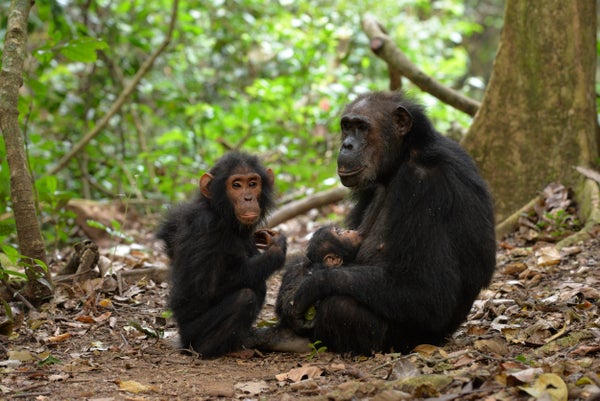
The four-year-old whined as he followed his mother away from his playmates; a brief tantrum failed to convince her to stay with the play group. This scene could conceivably play out between parent and child at any local playground, but in this case the scene took place in Tanzania’s Gombe National Park, and the sulking youngster was a chimpanzee named Grendel, who did not agree with his mother, Gremlin, that it was time to move on.
At this time of year, as we celebrate our mothers for the countless hours they spend caring, teaching and supporting us over our lifetimes, we can also take a moment to consider the importance of mothers in other species. As with most mammals, chimpanzee mothers play a crucial role in the lives of their infant offspring. For the first four to five years of Grendel’s life, Gremlin will serve as his primary source of nutrition, transportation and protection.
However, similar to humans and just a handful of other species, chimpanzees have a prolonged period of immaturity. Even after he can feed and move around independently, Grendel will continue to travel with Gremlin for an additional four to five years before venturing into chimpanzee society on his own. Throughout his lengthy development, Gremlin will be a close social partner and a model through which Grendel will learn about the social and ecological world around him.
On supporting science journalism
If you're enjoying this article, consider supporting our award-winning journalism by subscribing. By purchasing a subscription you are helping to ensure the future of impactful stories about the discoveries and ideas shaping our world today.
Any disruption of the close mother-offspring relationship prior to weaning is expected to have negative consequences. For example, mammalian infants that are orphaned before they can feed themselves face extremely low odds of survival. However, in species where offspring like Grendel continue to reside with their mothers for years after weaning, it is likely that a mother’s importance can extend beyond infancy.
Indeed, a previous study from Tanzania’s Mahale Mountains found that male chimpanzees orphaned at up to 13 years of age were less likely to survive than their non-orphaned counterparts. However, female orphans are harder to study since chimpanzee females typically leave their birth community around sexual maturity (approximately 11–13 years of age), which means they are lost to researchers. At Gombe National Park, about 50 percent of females remain in their birth community and many others transfer between neighboring research communities; thus, we are able to track their survival.
Using almost 60 years of data on the births, deaths, and disappearances of 247 male and female chimpanzees from two communities in Gombe, we were able to investigate the survival consequences of experiencing maternal loss during three age classes that represent different stages of chimpanzee development. The first five years of life equate roughly to infancy, which is the period before individuals are weaned and when young are most dependent on their mothers. Ages five to 10 approximate the developmental period known as juvenility, which is between weaning and puberty. Finally, the ages of 10–15 years correspond to adolescence and young adulthood.

Young female orphan. Credit: Ian Gilby
We found that males who lost their mothers in any of the three age classes, even as they were approaching adulthood, faced a significantly lower probability of survival than males whose mothers were still alive. Female chimpanzees followed a similar pattern up to age 10, but females who were orphaned between 10 and 15 years of age were as likely to survive as non-orphans.
Why this discrepancy between sons and daughters? It is likely a function of chimpanzee dispersal patterns. Since it is typical for chimpanzee females to lose contact with their mothers when they leave their birth communities, it is perhaps not surprising that a mother’s influence on her daughter’s survival disappears at the same age daughters typically leave home.
Of course, these results beg the question of how chimpanzee mothers are influencing the survival of their older offspring, particularly their almost adult sons. Previous studies of chimpanzees and other mammals provide us with some intriguing possibilities. As in killer whales, older females may be a source of ecological knowledge, providing older offspring with higher-quality food options.
In support of this explanation, a recent study of chimpanzee physical development found that orphans had significantly less muscle mass than non-orphans throughout juvenility. Beyond ecological knowledge, chimpanzee mothers provide their offspring with social support and a stable social bond, which is associated with lower stress, lower mortality and greater longevity in a number of species, including humans. Adult males have even been known to seek out and travel with their mothers after fights with other males. Conversely, orphans without mothers are often observed to be more anxious and exhibit depressive symptoms.
Regardless of exactly how chimpanzee mothers support the survival of their older offspring, it is clear that, as with our own species, mothers matter for much more than feeding infants. So even if your mother didn’t always let you stay and play with your friends, be sure to give her a call on Mother’s Day.