

This article was published in Scientific American’s former blog network and reflects the views of the author, not necessarily those of Scientific American
The launch of the space dog Laika onboard Sputnik 2 on November 3, 1957, was a historic milestone, the first demonstration that humans are capable of shipping life into the cosmos. But as is often the case, human hubris should be moderated by a broader perspective. Mother Nature has accomplished the same task many times over, when terrestrial rocks were launched into space as a result of asteroid impacts on Earth.
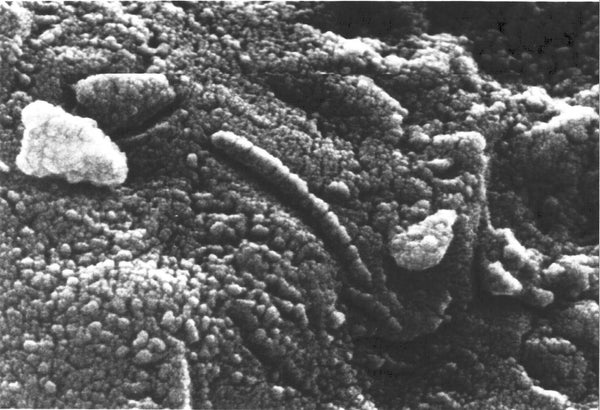
Some of those rocks likely had tiny astronauts, in the form of microorganisms in their belly. And other planets have reciprocated: nearly two decades ago, we learned that a Martian meteorite named ALH84001, which was found in Antarctica, was never heated above 40 degrees Celsius (104 degrees Fahrenheit) after being ejected from the surface of Mars. And a paper published in Science a few years prior had argued there was evidence for past biological activity inside the rock.
That assertion was ultimately rejected by most scientists, but the principle remains valid, raising the possibility that if organisms were transferred from Mars to Earth billions of years ago, they could have been the original seeds of life on our own planet. If so, we could all literally be Martians. Given the existence of this delivery system for biological organisms, it is natural to wonder whether a terrestrial package might have been sent not just to Mars but out of the solar system entirely long beforeVoyager 1 and 2 were launched.
On supporting science journalism
If you're enjoying this article, consider supporting our award-winning journalism by subscribing. By purchasing a subscription you are helping to ensure the future of impactful stories about the discoveries and ideas shaping our world today.
Most asteroid impacts are not powerful enough to eject terrestrial rocks with enough speed to leave the solar system. But many solar system bodies spend most of their time in the Oort cloud, a sort of comet nursery that hovers, loosely bound to the sun, at distances up to 100,000 times farther out than Earth. Some of these bodies appear episodically as long-period comets with eccentric orbits that bring them close to the sun, where they can get gravitationally kicked by planets all the way out of the solar system, like a ball running through a pinball machine.
Those that come very near Earth, passing just 50 to 100 kilometers above the surface, during this process could scoop up life from the atmosphere like a spoon passing through the foam atop a cup of cappuccino. While the abundance of microbes in the uppermost atmosphere is poorly constrained, it is well known that microorganism colonies exist at altitudes of 48 to 77 kilometers.
In a new paper written with my undergraduate student Amir Siraj, we calculate that there could have been tens of such life-exportation events over the lifetime of Earth. A similar number of events are expected to be associated with asteroids that came from outside the solar system before they grazed our planet’s atmosphere. This number would increase by orders of magnitude if life existed above an altitude of 100 kilometers during points in Earth’s history as a result of enhanced atmospheric turbulence or volcanic activity. Of course, these bodies cannot pass too close to the ground because air friction would slow them down and either force them to crash or burn them up.

Credit: Mike Lewinski Flickr(CC BY 2.0)
It is well known that fighter pilots can barely survive maneuvers with accelerations exceeding 10 gs, where g is the gravitational acceleration that binds us to Earth. But Earth-grazing objects would scoop microbes at accelerations of millions of gs.Could they survive the jolt? Possibly! Microbes such as Bacillus subtilis, Caenorhabditis elegans, Deinococcus radiodurans, Escherichia coli and Paracoccus denitrificans have been shownto live through accelerations just one order of magnitude smaller. As it turns out, these mini astronauts are far better suited for taking a space ride than our very best human pilots.
Even though the future of our space program lies with electronics that can be hardened by design to withstand harsh bombardment by cosmic rays and interstellar particles, it is humbling to realize that nature already accomplished one of our most ambitious technological goals long ago. Even as we’re launching state-of-the-art spacecraft such as New Horizons out of the solar system, we are also finding evidence for such natural interstellar traffic.
Cosmic history is mind-boggling. Just think: the newly discovered interstellar comet 2I/Borisov entered the last leg of its trip toward the solar system by passing the nearest star to the sun when the first humansfirst modern humans left Africa.