
This article was published in Scientific American’s former blog network and reflects the views of the author, not necessarily those of Scientific American
As aptly noted by shuttle veteran Don Pettit, humans are distinctly disadvantaged in seeking to achieve orbit. The problem, colloquially known as the “tyranny of the rocket equation,” is that as payload mass increases, so does the amount of propellant required to break free of Earth’s gravitational grip. Even among spacecraft of radically different design, the ratios are strikingly similar. The Saturn V rocket that took astronauts to the moon was 85 percent propellant by mass on the launchpad, nearly identical to the space shuttle. And the amount of payload mass hardly ever exceeds 4 percent of that of the entire rocket.
Thus, all launch vehicles suffer from Earth’s gravity with equal effect. While new discoveries in materials science are yielding tremendous advances in the structural integrity of spacecraft, only marginal improvements in the cargo-to-weight ratios have been found. The more one does the math, the less advantageous Earth-based launch becomes.
Consider this: Despite the generations of probes and robotic missions to Mars, some 34 million miles from Earth at its perigee, humans have never transited more than 1 percent of that distance in space. And yet, back in the 1960s, Wernher von Braun had dreamed of, and designed, spacecraft to accomplish that feat by the 1980s.
On supporting science journalism
If you're enjoying this article, consider supporting our award-winning journalism by subscribing. By purchasing a subscription you are helping to ensure the future of impactful stories about the discoveries and ideas shaping our world today.
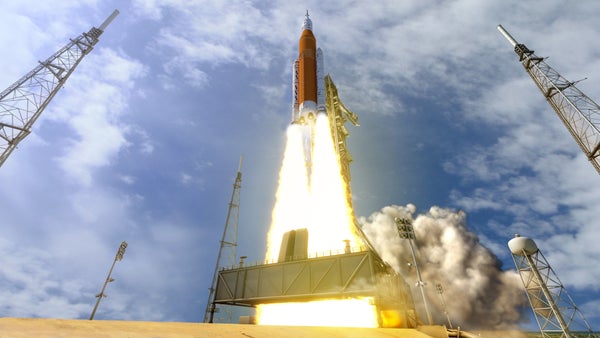
Unfortunately, rather than continue to improve upon the Saturn V, American political will atrophied and the nation receded from its spacefaring ambitions. The subsequent years found our reach limited to a short shuttle trip 250 miles upward. In fact, until the development of the Space Launch System (SLS), there was not even a vehicle capable of returning astronauts to the moon, let alone Mars.
However, with SLS core engine stage testing underway at NASA’s Stennis Space Center, America is fast approaching a return to deep space. And with the evolution of the SLS to its Block 2 variant with a payload capacity of nearly 100,000 pounds per launch, the nation will finally realize the dream of a permanent lunar outpost.
While the reusability of low-Earth orbit launch vehicles and crew modules can improve cost efficiency, deep space missions require payloads on an inherently larger scale.
The lunar surface isn’t simply a destination, it is more akin to a training and equipping station. With its gravity well only one sixth of Earth’s and a rich array of chemical elements, the moon will be a staging ground for missions further afield. However, for that to occur, early human explorers will need significant materiel support. That is where the SLS will make all the difference.
Significantly, the past few decades of deep space exploration have revealed the omnipresent biological building blocks of oxygen, nitrogen, potassium and even calcium. So, we know humans can live off Earth. But we don’t just want to survive; we want to thrive. Fortunately, metals key for industrial application, such as aluminum, nickel, cobalt and titanium, happen to be incredibly abundant throughout the inner solar system. With SLS coming online, space exploration and habitation will shift from sole Earth dependency into an era of self-sustainment.
While initial settlement activities will surely require prefabricated shelter and energy generation modules, a sustained lunar presence will necessitate use of local resources. As deep space supply chains will always be tenuous, scalable human occupation must rely on lunar extraction and manufacturing operations with ever-expanding capacity to ensure adequate supply of food, air, water, rocket propellant and construction materials. Indeed, the industrial learning curve will be steep, but the multinational and commercial enthusiasm already underway demonstrates the shared commitment to identify and overcome obstacles as they arise.
As U.S. Chamber of Commerce CEO Tom Donohue recently wrote, “We are in the early stages of an economic revolution that could redefine the limits of humankind. Space isn’t an empty void but a landscape of endless possibility.”
Perhaps we cannot trick the laws of physics as seen on the Hollywood screen, but SLS will decisively overcome Earth’s gravity and set us on a course to boldly go where no one has gone before.