

This article was published in Scientific American’s former blog network and reflects the views of the author, not necessarily those of Scientific American
When it comes to tackling the climate crisis, ending $400 billion in annual subsidies to the fossil-fuel industry worldwide seems like a no-brainer. For the past decade world leaders have been resolving and reaffirming the need to phase them out. All the 2020 Democratic presidential candidates committed to eliminating fossil-fuel subsidies, and the vast majority of the American public supports doing so. International financial institutions such as the World Bank and International Monetary Fund have joined the chorus, pointing to the benefits of reform.
In 2018, however, a group of researchers questioned the magnitude of the climate benefits of subsidy reform, reporting that their simulations showed its effect would be “limited” and “small.” Stories in the press began asking whether such subsidies are such a big deal after all.
We think this is wrong. In a paper in February in the journal Nature, we make the case that they do matter—a lot. In the 2018 study, emissions reductions from subsidy removal were calculated by the researchers to be 500 million to two billion metric tons of carbon dioxide a year by 2030. This figure is by no means “small.” It amounts to roughly one quarter of the energy-related emissions reductions pledged by all the countries participating in the Paris Agreement (four billion to eight billion metric tons). Hundreds of millions of metric tons of CO2 reductions is nothing to sneeze at, particularly when it can be achieved by a single policy approach that also brings strong fiscal, environmental and health benefits.
On supporting science journalism
If you're enjoying this article, consider supporting our award-winning journalism by subscribing. By purchasing a subscription you are helping to ensure the future of impactful stories about the discoveries and ideas shaping our world today.
Moreover, previous work has more than likely underestimated the emissions reductions that would occur because commonly used techniques do not accurately capture the investment dynamics of fossil fuels. But these dynamics can greatly affect what oil and gas companies do.
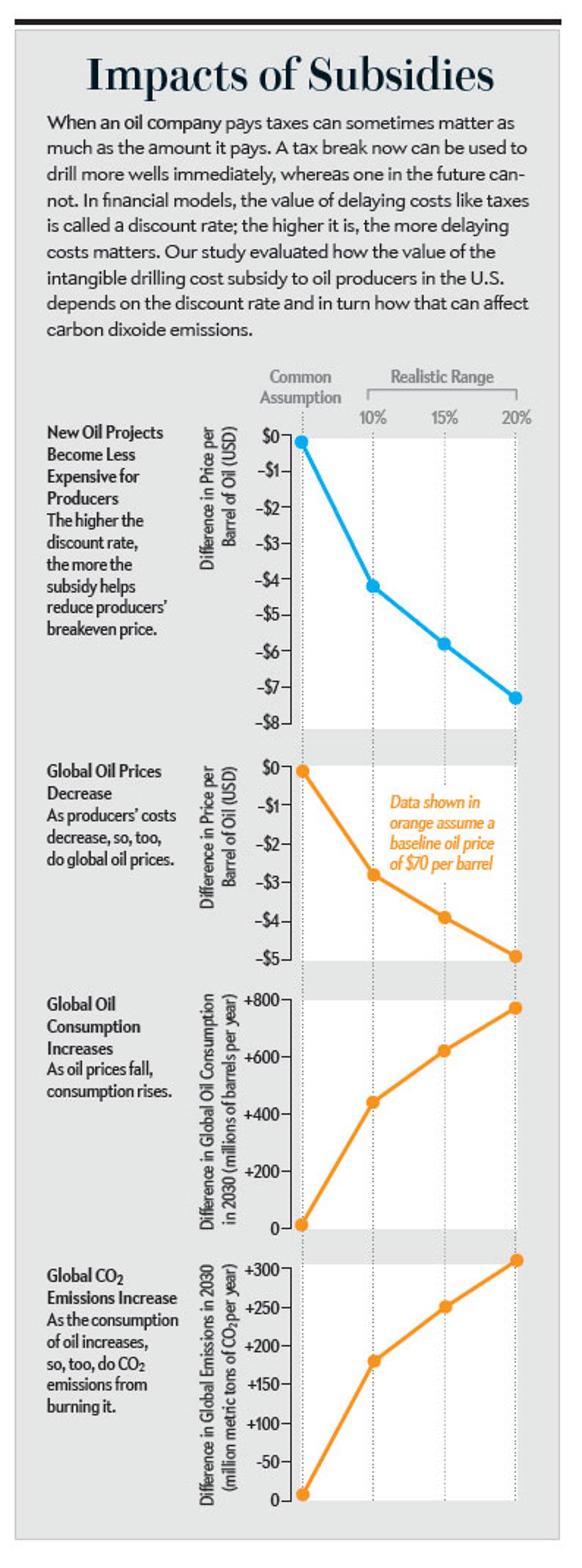
Credit: Amanda Montañez; Source: “Why Fossil Fuel Producer Subsidies Matter,” by Peter Erickson et al., in Nature, Vol. 578; February 5, 2020
In our analysis of the issue, we take the example of one specific subsidy: a federal tax break that allows U.S. oil producers to immediately deduct from their taxes most of the costs of constructing and drilling new wells. Conventional models assume that such subsidies are uniformly distributed across all oil fields, whereas in reality, governments often preferentially target new—rather than existing—capital investments. The result is a lowering of producers’ up-front cash-flow requirements, leading them to drill more new wells than they otherwise would. This process locks in and accelerates fossil-fuel production and, in turn, greenhouse gas emissions. We estimate that true emissions reductions from eliminating this tax-break subsidy could be more than an order of magnitude greater than was predicted using the conventional modeling approach.
And this tax break is just one subsidy. A separate, peer-reviewed analysis by some of us in 2017 demonstrated that without a dozen key subsidies, nearly half of U.S. future oil production could be unprofitable at $50-per-barrel oil prices—the level at which prices may hover in a low-carbon future.
In other countries, the forms of subsidies can, of course, vary. But around the world, fossil-fuel production and consumption are supported in hundreds of ways. Indeed, the most troubling impact and legacy of fossil-fuel subsidies may be the political barriers—rather than financial ones—that fossil-fuel producers have erected against decarbonization efforts over a period of decades. Revenue boosts from subsidies can support not only more drilling but also product promotion, political activities and other efforts that reinforce the industry’s incumbent status. Subsidies also have a symbolic effect, signaling that this industry and its activities are beneficial for society as a whole and that they therefore should be encouraged.
In another paper, published in a February issue of the Proceedings of the National Academy of Sciences USA, experts studying the social tipping points for climate stabilization concluded that “redirecting national subsidy programs to renewables ... or removing the subsidies for fossil-fuel technologies are the tipping interventions that are needed for the takeoff and diffusion of fossil-fuel-free energy systems.”
Economic models provide useful guidance to policy makers. But as we show in our article, most have a blind spot, failing to capture key ways in which subsidies send signals to markets and people. Overreliance on these models can create a false sense of certainty that misses the big picture: of course, subsidies matter to the fossil-fuel industry and help to prop it up. That is why they were introduced in the first place and why the industry and its allies continue to defend them. As the Department of Energy itself concluded 40 years ago, federal subsidies have had a “large effect” on capital formation and oil production in the U.S. And more oil infrastructure and more production mean more greenhouse gas emissions.
The public and policy makers should be under no illusions about the basic realities at stake: Holding back catastrophic global warming requires dramatically reducing fossil-fuel production. And subsidies to fossil-fuel companies undermine that goal. Once upon a time, it made sense for countries to support their fossil-fuel industries. But that time is over.