

This article was published in Scientific American’s former blog network and reflects the views of the author, not necessarily those of Scientific American
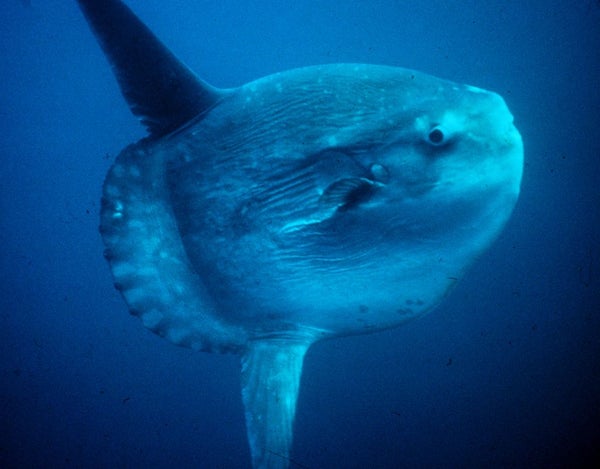
What weighs up to 5,000 pounds, looks permanently distraught, and relies on interspecies friends for basic hygiene? The ocean sunfish is the world’s heaviest fish, with an unusual appearance—not so much a fish as a frowning head with fins. Sunfish also have the dubious fortune of possessing high parasite loads, with 54 described species of parasites occurring on them. But since ocean sunfish don’t have hands or any way to remove their parasites themselves, they rely on seabirds to lend a hand—or beak.
The process goes as follows: ocean sunfish swim to the surface of the water and lay flat on it. Nearby birds take notice and pick parasites off of the fish. If necessary, sunfish appear to actively encourage birds to do this by swimming directly next to them or even following them. This situation seems perfect for everyone involved: the birds obtain an easy meal and the sunfish get a spa day.
Biologists call this kind of relationship a cleaner-client mutualism: the birds are cleaners, sunfish are their clients, and both individuals benefit from the relationship, hence mutualism. Such relationships seem to occur frequently in the animal kingdom: mongooses climb on top of warthogs to eat parasites, oxpecker birds eat ticks off of hippos, and some 131 species of fish and shrimp clean fish by picking off dead skin and parasites (Finding Nemo fans may remember Jacques, the French-accented shrimp, fastidiously cleaning his fish friends).
On supporting science journalism
If you're enjoying this article, consider supporting our award-winning journalism by subscribing. By purchasing a subscription you are helping to ensure the future of impactful stories about the discoveries and ideas shaping our world today.
It sounds like a good deal for all parties, until you remember that fish frequently eat shrimp, and that client fish could easily eat the cleaner shrimp after their services have already been rendered. Similarly, cleaners can also fail to uphold their end of the bargain. After all, why stick to cleaning when there are tastier things to eat? Fish produce a mucous layer that protects them from bacteria and UV rays, and cleaner fish actually prefer eating that mucus to the dead skin of the fish. Given the chance, cleaner fish sneak bites of mucus, which harms client fish since it makes them susceptible to infection and skin damage. So why do animals ever participate in cleaner-client mutualisms, given that there’s a real risk of being eaten or harmed?
As it turns out, participants employ specific techniques to keep each other honest. To make sure that cleaner fish don’t cheat, potential client fish “eavesdrop” on cleaners by watching them clean other clients. The potential clients then prefer to visit cleaners whom they have witnessed being honest to the cleaners that they don’t know anything about. As a result, cleaners are less likely to cheat when they see potential clients nearby—not all that different from a child checking to see if anyone is watching before sneaking a slice of cake. When cleaner fish do eat mucus, clients punish them by ending the cleaning, sometimes aggressively chasing the cleaner, and occasionally even eating them (truly the ultimate punishment for being too greedy).
A different way that cheating is kept to a minimum is through reciprocity. Just like humans return to the same businesses again and again if treated fairly, clients revisit good cleaners repeatedly. Similarly, cleaners may be more willing to provide services for clients that have behaved well in the past. For this to work, the same individuals must encounter each other again and again.
Most of the research on what prevents cheating in a cleaner-client relationship has focused on smaller fish as both cleaners and clients—it’s hard to keep, say, ocean sunfish or seabirds in the lab, much less experimentally manipulate their behavior. But by studying systems that are experimentally feasible, biologists can gain greater insight into the evolution of cooperative behaviors in animals as well as people. Humans often have severe punishments for those who cheat, and reciprocity too is something that encourages humans to cooperate with one another. While our hygiene may be much more sophisticated than the ocean sunfish’s, our motivations for cooperating with others may not always be.