
This article was published in Scientific American’s former blog network and reflects the views of the author, not necessarily those of Scientific American
It is a Jewish tradition during the Passover Seder to hide a piece of matzo, called the “afikoman,” for the children to find later in the evening and receive a reward. As kids know well from this experience, the question of “Where to look?” is more urgent than “What exactly are we looking for?” The simplest strategy is to search in places where the afikoman was found in the past. This is exactly the strategy adopted by astronomers in the search for extraterrestrial life. Their current search strategy focuses on rocky planets in the habitable zone of stars, consistently with the only place where life has been found so far: Earth.
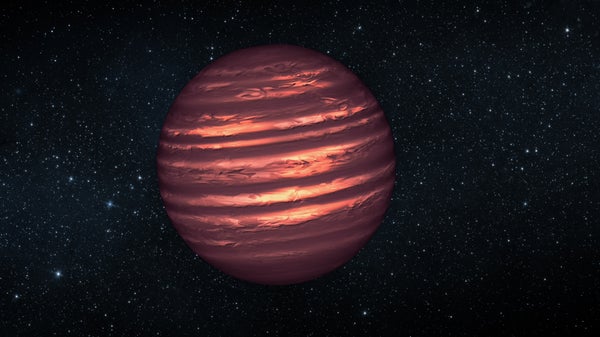
But are places like Earth the most likely sites for finding life? I have discussed this question recently with my postdoc Manasvi Lingam, and discovered a surprising answer. Most places where the chemistry of life as we know it could blossom might be in the atmospheres of the not-quite stars known as brown dwarfs, where liquid water might exist on the surfaces of tiny solid particles in clouds.
Within our solar system, the clouds of Venus were suspected of being habitable for over 60 years. Brown dwarfs are small objects with up to about 70 times the mass of Jupiter (7 percent of the mass of the sun or a bit more), which are not capable of burning nuclear fuel and hence steadily lose their internal heat of formation and cool to planetary temperatures. The most common brown dwarfs have had a surface temperature similar to the Earth for far longer than the time it took for life to develop once the early Earth cooled.
On supporting science journalism
If you're enjoying this article, consider supporting our award-winning journalism by subscribing. By purchasing a subscription you are helping to ensure the future of impactful stories about the discoveries and ideas shaping our world today.
The emergence of life could accelerate if a brown dwarf’s atmosphere is illuminated by ultraviolet light from a companion star. In that case, what would be the best method of searching for the “afikoman of life?” Our paper suggests looking for “green dwarfs”—that is, the green surfaces of objects whose surface temperature would naturally classify them as “brown” if not for the existence of life.
A well-known spectral feature of vegetation on Earth is the “red edge” in reflected light. Plants use photosynthesis in processing nutrients. Their internal chemistry uses visible and ultraviolet light to break chemical bonds and digest essential molecules, while rejecting infrared photons that are not energetic enough to be useful in this process. As a result, the vegetation-covered surface of the Earth exhibits a sharp spectral edge in its reflectance as a function of wavelength. It reflects infrared light as if it were trash and absorbs light at shorter wavelengths. The atmosphere of a green dwarf that hosts life should show this spectral feature.
The hunt for life may therefore be simpler than previously thought. First, one would search for sunlike stars that have a companion brown dwarf in their habitable zone. About half of all stars have a companion, and about a tenth of these companions would involve a habitable brown dwarf. Altogether, there should be billions of such systems in the Milky Way galaxy. For any of these abundant systems, one should search for a red edge in the spectrum of the companion. Since a brown dwarf companion is tens of times larger in size than an Earth-like planet, it should reflect a thousand time more starlight than the Earth does. This would make the detection of the red edge much easier.
Hence, searching for green dwarfs around sunlike stars might be our best bet for the location of our astro-iological afikoman. We better search for the keys of life under such a lamppost first, since it will be far more challenging to find it elsewhere.
Needless to say, discovering extraterrestrial life would change our perspective on our place in the universe. But identifying it in environments different than the surfaces of Earth-like planets would allow us also to figure out whether there is only one chemical path leading to life. If we uncover surprises about the chemistry life in space, we would be motivated to produce additional variants of synthetic life in the laboratory, with potentially major benefits for medicine.
In the last class of my freshman seminar at Harvard University, I asked the students whether they would choose to board a spacecraft stewarded by friendly aliens for an adventurous journey back to the aliens’ home. Most students answered in the affirmative—provided that they would be allowed to share their unique experience on social media and chat about it with friends.
What I did not tell the students is that among alien civilizations, it is common knowledge that when your star dies you create your own habitable zone using a nuclear reactor to keep yourself warm. So, the alien home might not possess the green beauty of our world. But there is also a reason to hope that the aliens might navigate towards the green clouds of their host brown dwarf.