
This article was published in Scientific American’s former blog network and reflects the views of the author, not necessarily those of Scientific American
In a crisis like the one we face now, one of the most important resources is trust. Communities need to pull together based on clear, reliable and honest information from experts. Unfortunately, that trust is undermined with every White House press event.
As of late March, the Centers for Disease Control’s last press conference was on March 9. For more than two weeks, the White House has seized control over communication around the novel coronavirus, leading to confusion and distraction when we need clarity, focus and unity.
A responsible White House would coordinate a government-wide response to the crisis. They would allow experts to be the public face of that effort, and reinforce the expert advice. Instead, scientists brief the president, cross their fingers and hope for the best, an approach that has been shown to be an unmitigated disaster.
On supporting science journalism
If you're enjoying this article, consider supporting our award-winning journalism by subscribing. By purchasing a subscription you are helping to ensure the future of impactful stories about the discoveries and ideas shaping our world today.
President Trump routinely tells things like he wishes they were, not as they are. We don’t need inaccurate rosy pictures. We need the truth.
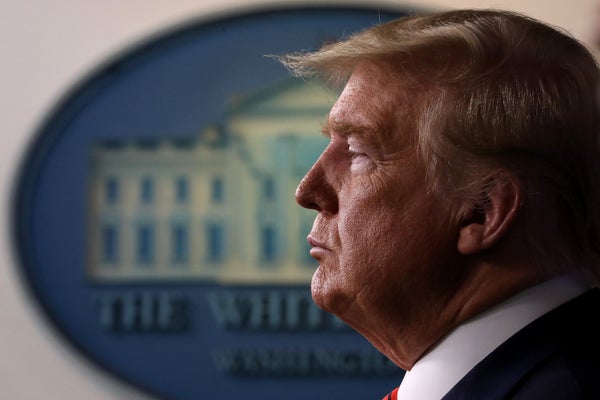
Currently, every presidential “press conference” that is carried live immediately hobbles our collective ability to mitigate the coronavirus illness COVID-19. We have already lost valuable time, with some communities downplaying or ignoring the pandemic because of the president. This is aided and abetted both by partisan media sympathizers and by journalists who share misinformation live and correct it later.
The White House has spent the last several days deflecting blame for this crisis, refusing to take any responsibility and doing its best to pin it on China in spite of the xenophobic collateral damage. Yet while the Trump White House isn’t the cause of this pandemic, it certainly is an accelerant.
It is glaringly obvious how many chances the Trump administration had to prepare the country to meet the challenge of a pandemic, but didn’t. Transition teams dismissed pandemic preparations. The White House cut disease surveillance programs and dismantled internal response capability and expertise. They ignored intelligence briefings.
And now, the daily White House events are an exercise in confusion and contradiction. President Trump seems increasingly willing to cast doubt on the need for social distancing in order to prop up the stock market. And his misleading statements about a potential treatment for COVID-19 resulted in some people being poisoned by the drug and caused critical shortages for people who need it.
We need a new approach to sharing the best available information about this pandemic. Carrying the president’s press conference live is now irresponsible. Margaret Sullivan argues in the Washington Post for these events to be delayed and fact-checked. During a pandemic, the media must go farther, and refuse to air information that can be verified as false.
The press must ensure that everyone has access to current information about how to best protect themselves. Fortunately, there is so much expertise domestically that we can tap into, from the CDC to the American Public Health Association. And we can learn from the World Health Organization’s daily press conference and the experiences of other countries to inform our own.
In a vacuum of leadership, it is up to all of us to amplify the messages of public health officials so they stick, everywhere. Public health experts understand how to communicate critical health and safety information in times of crisis. They have practiced for this very moment. A CDC disaster communications guide details evidence-based procedures for building society-wide credibility and trust while communicating ever-evolving information.
Reporters and opinion can supplement information provided directly by the CDC and WHO by continuing to make connections with public health authorities and experts. Is personal protection equipment for medical personnel being provided in sufficient quantities? What are local health departments’ greatest needs? Who is most at risk? How are we protecting marginalized populations? What are the weak links? Where are people meeting the challenge?
That means, in the words of journalism scholar Jay Rosen, “exiting from the normal system for covering presidents.” Just because it happened doesn’t mean it should be amplified.
In the words of the CDC: Be first. Be right. Be credible. These proven practices save lives. But under the thumb of the White House, they are in danger.
We need science, not a political public relations machine. We need to know what the scientists know. Not so that powerful people can hoard information and sell off their stocks, but so all of us can protect our families and our communities.
This pandemic is going to get worse before it gets better. We desperately need an information environment that is consistent and clear and puts evidence first.