
This article was published in Scientific American’s former blog network and reflects the views of the author, not necessarily those of Scientific American
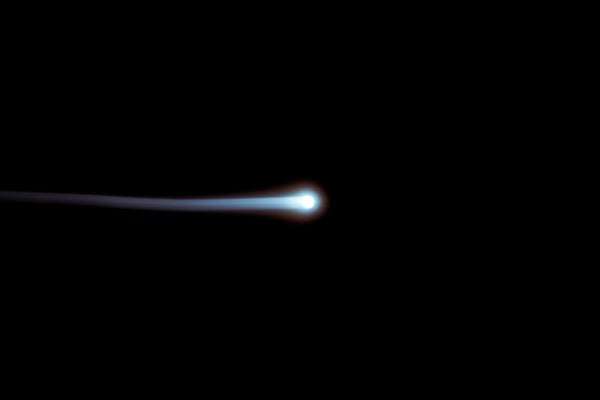
Last month I was invited to a radio interview about a recent meteor over the Bering Sea which was spotted off Russia’s Kamchatka’s peninsula on December 18, 2018 after producing a blast with 10 times the energy of the atomic bomb over Hiroshima. In preparation for the interview I searched the literature online and came across a catalog of all meteors over the past three decades, ordered by the strength of the fireball they produced.
These objects were discovered by a classified system of detectors owned by the United States government, which used the sound waves and light they produced in the Earth’s atmosphere to determine the three-dimensional components of their velocity and position at the time of impact.
Impressed by the most powerful fireballs, I asked an undergraduate student, Amir Siraj, who has been working with me on ‘Oumuamua—the first interstellar object discovered in the solar system—to calculate the past trajectory of the fastest meteors in the catalog, starting from their detected position and velocity at impact, and taking account of the gravity of the Earth, the sun and all distant planets within the solar system.
On supporting science journalism
If you're enjoying this article, consider supporting our award-winning journalism by subscribing. By purchasing a subscription you are helping to ensure the future of impactful stories about the discoveries and ideas shaping our world today.
The trajectory of the fastest object ended up being bound to the sun since it involved a head-on collision with the moving Earth. The second fastest was definitely unbound to the sun. The third fastest was possibly bound within uncertainties. The surprising result about the second fastest meteor in the catalog was conveyed through a surprising e-mail from Amir saying: “We might have discovered the first meteor which originated outside the solar system!” A few days later, we posted our paper on the arXiv and simultaneously submitted it for publication in Astrophysical Journal Letters.
There is an important moral to this story. Media appearances are not a waste of time. They can raise questions that inspire scientific breakthroughs.
In retrospect, meteoric fireballs offer an ideal opportunity for learning about interstellar objects. The traditional search method uses the sun as a lamppost and looks for objects based on the light they reflect. This is how ‘Oumuamua was detected by the Pan-STARRS telescope. The limitation of this survey technique is that it is limited to objects larger than a hundred meters, since smaller objects are too faint to be detected by Pan-STARRS.
Naturally, one would expect smaller objects to be more abundant—so much so, that some of these might hit the Earth at a noticeable rate despite its small cross-sectional area. And so, the Earth's atmosphere ends up serving as a detector for meter-size interstellar objects. And since meteors burn up in the atmosphere, spectroscopy of the gases they emit can be used to infer their composition even if they leave no relic behind.
The second fastest interstellar meteor in the catalog was spotted just north of Manus Island, off the coast of Papua New Guinea. It produced a blast of merely a percent of the Hiroshima bomb, implying a meter-size object with a mass of about 500 kilograms. Given the inferred impact rate of roughly once per decade, we concluded that there should be roughly a million such objects inside the orbit of the Earth around the sun. These meter-size objects carry as much mass per volume of space as ‘Oumuamua-like objects that are a hundred times bigger.
The reported meteor entered the solar system with a speed of 60 kilometers per second relative to the local standard of rest, the frame of reference obtained by averaging the motion of all stars in the vicinity of the sun. Such a high speed can be produced through ejection from the innermost region of a planetary system, where the characteristic orbital speeds are of comparable magnitude. In the solar system, the relevant region is interior to the orbit of Mercury.
But for dwarf stars like our nearest neighbor, Proxima Centauri, the required ejection region overlaps with the habitable zone, which is 20 times closer in since the star is much fainter than the sun. Since dwarf stars are most common, the detection of this meteor offers new prospects for “interstellar panspermia,” or the transfer of life between planets that reside in the habitable zones of different stars. This might be possible as long as the meteor is big enough so that it does not burn up completely in the Earth’s atmosphere. To seed life, the required impact rate is merely once per billion years, allowing for a much bigger object that could survive entry to the target planet.
To make the inferred population of meter-size interstellar meteors, each star needs to eject about 1022 objects, totaling about an Earth-mass worth of material. This requirement is at tension with the expected mass in planetesimals within the orbit of Mercury in the early solar system.
Using the Earth’s atmosphere as a detector for interstellar objects offers new prospects for inferring the composition of the gases they leave behind as they burn up in the atmosphere. In the future, astronomers may establish an alert system that triggers follow-up spectroscopic observations to an impact by a meteor of possible interstellar origin. Alert systems already exist for gravitational wave sources, gamma-ray bursts or fast radio bursts at the edge of the universe.
Even though interstellar meteors reflect the very local universe, they constitute a “message in a bottle” with fascinating new information about nurseries that may be very different from the solar system. Some of them might even represent defunct technological equipment from alien civilizations, which drifted towards Earth by chance, just like a plastic bottle swept ashore on the background of natural seashells.