
This article was published in Scientific American’s former blog network and reflects the views of the author, not necessarily those of Scientific American
This dispatch is from the not so distant past.
It is time to see a patient. We flock together as a team: attending physician, a handful of resident physicians, a cohort of medical students, the hospital floor’s charge nurse, the bedside nurse, a respiratory therapist, a pharmacist, a pharmacy student and maybe a few others. We gather outside the patient’s room and are about to enter.
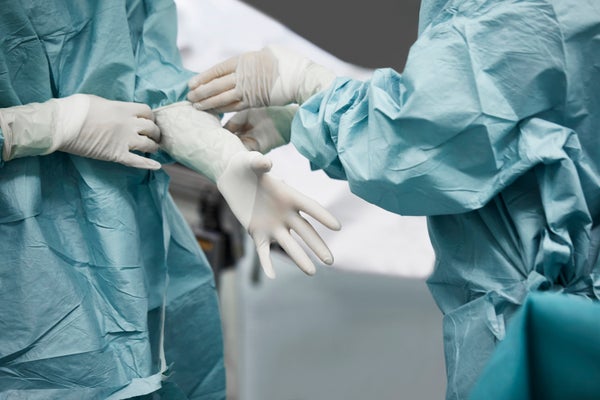
One of the team members hands out personal protective equipment (PPE) including gloves, gown and mask to the rest of the team; the patient has a respiratory illness and is on droplet precautions. Somewhere along the line, a mask accidentally hits the floor, a glove rips. More PPE is distributed. Finally, the team is ready.
On supporting science journalism
If you're enjoying this article, consider supporting our award-winning journalism by subscribing. By purchasing a subscription you are helping to ensure the future of impactful stories about the discoveries and ideas shaping our world today.
It may seem wasteful, but it is medicine—or at least how we learned to practice it—before COVID-19.
Until now, the health care education system required multiple providers, from varied educational backgrounds and training levels, to be at the bedside in patient rooms. The education system required the pack of health care workers to be present to learn the nuances of disease in order to learn how to best take care of patients.
In modern health care, if you are not at the bedside, you are not learning. But with the chronic, global shortage of PPE we face today, I am haunted by thinking of all the discarded masks, gloves and gowns, even if they were superfluous in the spirit of education.
U.S. health care professionals are taught to practice medicine in ideal conditions, with the assumption that resources and supplies are ample and readily available. But today’s reality is a result of a long-term underinvestment in preparedness, placing moral distress on physicians when they are unable to carry out their oath to do no harm.
This distress transcends to all health care employees, as the current crisis does not only highlight a limited supply of resources, but a limited supply of personnel such as respiratory therapists.
Although there are efforts to teach physicians high-value, cost-conscious care, these types of curricula teach avoidance of wasteful diagnostic and treatment options that do not affect patient outcomes.
Even simulation curricula like Helping Babies Breathe, an American Academy of Pediatrics health initiative to improve health outcomes of babies who struggle to breathe at birth, is created specifically for resource-limited environments in developing countries.
Most U.S. health care workers do not learn these simulation curricula because they are usually only needed in resource-scarce areas, not the U.S. But today, in the midst of the global pandemic affecting all 50 states, we are just as resource-limited as our neighbors; attempting to MacGyver solutions to save our patients.
When learning how ventilators work, health care professionals do not learn that two patients can use one ventilator. When learning the science behind how a respiratory virus spreads, we do not learn that the way to protect yourself from contracting it will be different tomorrow than the way it is today—because tomorrow you will not have appropriate protection.
We are scientists. And in crisis, scientists can attempt to manipulate how we do things if it means the difference between life and death. But we were never taught how to practice medicine in compromised conditions—never mind a global pandemic. Instead, we were taught that resources like PPE were a right, not a privilege, when taking care of others.
The COVID-19 death toll has risen to over 11,000 in the U.S. with nearly 380,000 cases nationwide, and more than 1.3 million cases worldwide with over 78,000 deaths, according to Johns Hopkins data as of April 7.
Recently, medical schools in New York and Boston announced plans for early medical school graduation in order to supplement the need for more physicians. These new doctors will do honorable work at the front lines of a worldwide crisis—just not one that they have trained for.
Pandemics have devastated global populations before, from the plague of the middle ages to the 1918 flu, Polio, Ebola and H1N1. Those who research in science and practice in medicine need to heed the lessons of the past and the present to make sure that the next time we are prepared.
Read more about the coronavirus outbreak here.