
This article was published in Scientific American’s former blog network and reflects the views of the author, not necessarily those of Scientific American
We’re flying 43,000 feet above the Antarctic Circle, in the Southern Ocean. There are no other people for thousands of miles, and the only light visible in any direction is from the moon and from the aurora australis—the southern lights. There is nothing to see in this vast isolation except for the waves and the clouds bathed in moonlight. Out here, if anything happens, we are on our own.
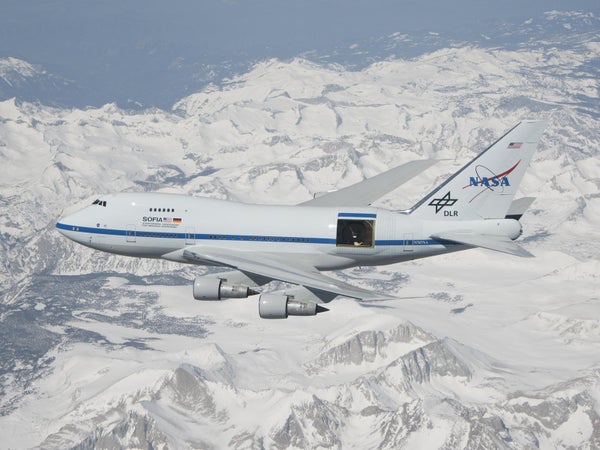
We are here aboard the world’s only flying observatory because nowhere else on the planet has such ideal conditions for astronomy—it’s the next best thing to outer space. Known as the Stratospheric Observatory for Infrared Astronomy (SOFIA), the mission is a joint one between NASA and the German Aerospace Center (DLR) to hunt for infrared light from sources ranging from the galactic center to the dusty interstellar nebulae where stars are born. From the ground, most infrared light is blocked by water vapor in our atmosphere—but at this altitude, 99 percent of that vapor is below us.
That’s why, in 1997, NASA bought a Boeing 747SP originally flown by Pan American Airways The aircraft was modified to include an open cavity that could house a 2.5-meter (eight-foot) diameter telescope, housed behind a door that can be opened and shut during flight. The back end of the telescope is protected by a pressurized bulkhead so the instrument and telescope operators can safely take data during observations. It may sound crazy to fly around with a telescope—but it’s still far easier and cheaper than launching a satellite like the Spitzer Space Telescope to study these otherwise blocked wavelengths.
On supporting science journalism
If you're enjoying this article, consider supporting our award-winning journalism by subscribing. By purchasing a subscription you are helping to ensure the future of impactful stories about the discoveries and ideas shaping our world today.

Back end of the telescope. Credit: Floris Looijesteijn
OFIA has been flying several times a week from Edwards Air Force Base in Palmdale, Calif., since 2010. Two months of the year, however, the aircraft is based at the Antarctic Center in Christchurch, New Zealand, during the Southern Hemisphere’s winter. During this time, the observatory is focused on targets impossible to observe from the north, such as the Magellanic Clouds that are satellite galaxies of our Milky Way. Which is precisely why I found myself in the jump seat of this airborne observatory on a clear evening at the Christchurch airport, waiting for takeoff. The pilot had offered, and I like to begin my adventures in style.
The first thing to know about SOFIA is that it takes complex flight paths that are planned out to the minute. The reason is that while the telescope can move vertically and has gyroscopes to counter turbulence, any horizontal motion to track an object is done by literally reorienting the plane itself. As the stars move overhead, the airplane has to be in exactly the right spot to see a particular object. If takeoff is delayed for even a few minutes due to weather or problems with an instrument, the entire evening’s observations may have to be called off, and the astronomer or astronomers who have a reservation on this particular flight will have to wait at least another year for their data.
The second thing is that SOFIA is an impressive and complicated operation, carrying about two dozen people on observing flights. These range from the telescope operators, who keep the scope is properly locked onto guide stars; the mission directors, who make sure everything goes according to plan; and the astronomers themselves who are busy analyzing the arriving data. (The data from my flight haven’t been published yet, so we were asked to not take photographs of the astronomers’ area; but they were observing objects including the center of our galaxy, a dusty galaxy beyond the Milky Way and active star-forming regions in interstellar space.)
SOFIA has two mission directors. The primary is responsible for overseeing everyone and keeping the pilot on course, and the secondary keeps SOFIA clear of other air traffic. The latter is a complicated task in United States airspace, but far easier on our wintery sojourn over the Southern Ocean, where, he says, “every once in a while, we see a Sydney-to-Santiago flight 500 miles away and wave hello.”
Why go through all the trouble to view the universe in the infrared? It’s because the majority of the normal matter out there (i.e., everything besides the mysterious dark matter) is not in stars or planets, as you might imagine, but locked in dust clouds, which glow with infrared light. When stars begin to form, they’re cloaked in dust, and there is no better way to study them without going into space than SOFIA.

The author (right) and the photographer. Credit: Floris Looijesteijn
Recently, for example, astronomers released a detailed 3-D map of the Orion Nebula, the closest star-forming nursery to Earth, allowing astronomers to see structures from the stellar winds and the molecular composition of the nebula for the first time. Such a rendering is priceless for understanding how stars are born and is impossible from the ground; with SOFIA it only took a few nights of observing to put together.
Eventually, the activity on board SOFIA settles into the purposeful calm rhythm of observing that you can find at any observatory on Earth when everything is going smoothly. Those whose primary duties are finished can be found in the handful of “normal” airline seats, catching a snooze or the latest on Netflix. (Unlike a normal flight, there is no catering except for a coffee pot. The microwave is disabled too because it would interfere with the astronomical instruments, so no hot meals.) And when the pilot spots the southern lights, there’s no attempt to rouse the staff for a look; this is old hat for the those who have the run of the world’s only flying observatory.
Eventually, near the southernmost point of our observing run before heading north, the pilot does make an announcement: “For those interested in such trivia,” he drawls, “we are south of the Antarctic Circle. On our left you can see islands that are considered part of Antarctica.” Several staff do head to the (relatively few) windows for a look at the ghostly, moonlight-bathed peaks below. This bit of incidental tourism is special.

The author, pointing to the southernmost point on the flight. Credit: Floris Looijesteijn
And then airplane turns north, back to New Zealand, and the telescope points at a new target. SOFIA is back to the same old routine—providing answers to mysteries about the universe you can’t find anywhere on Earth