
This article was published in Scientific American’s former blog network and reflects the views of the author, not necessarily those of Scientific American
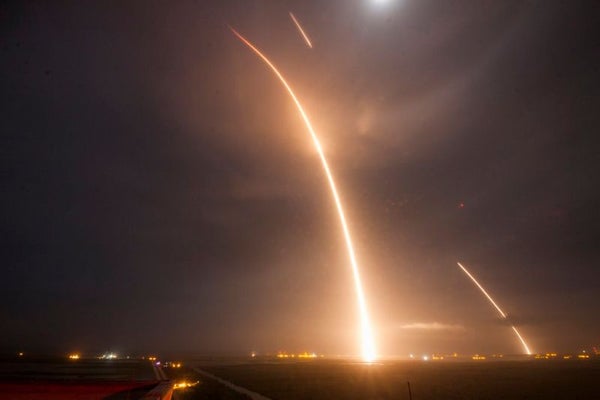
The winter solstice made last night the longest and darkest of the year, but the skies over Florida were filled with light, not once, but twice. First when a Falcon 9 rocket from SpaceX launched a payload of satellites into orbit from Cape Canaveral Air Force Station, and again nine minutes later when the 15-story-tall first stage of the rocket returned to Earth, riding its fiery jet to a gentle landing.
Though dreamed of for decades by aerospace engineers, such a landing was long considered the stuff of science fiction. “It’s a revolutionary moment,” SpaceX founder CEO Elon Musk said in a press conference shortly after the landing. “No one has ever brought a booster, an orbital-class booster, back intact.” By reusing rockets, Musk said, the total cost of sending cargo and crews to orbit could eventually be reduced by more than a factor of a hundred—cheap enough to open the heavens to all manner of new activities, including Musk’s dream of retiring on Mars.
Last month, another spaceflight company, Jeff Bezos’s Blue Origin, launched and vertically landed its New Shepard spacecraft during a test in Texas, but the flight only reached suborbital altitudes—a much less difficult feat than vertically landing a rocket coming back from orbit. Several other companies are still pursuing reusable suborbital and orbital launch systems, but for now, SpaceX has a clear and perhaps unassailable lead.
On supporting science journalism
If you're enjoying this article, consider supporting our award-winning journalism by subscribing. By purchasing a subscription you are helping to ensure the future of impactful stories about the discoveries and ideas shaping our world today.
Even so, the landing comes after a string of accidents that, combined with the successful Blue Origin demonstration, placed intense pressure on SpaceX to prove its mettle. Last year two of SpaceX’s competitors experienced disastrous launch failures that plunged the commercial spaceflight industry into turmoil. Then, six months ago, bad luck struck SpaceX as well, when an uncrewed Falcon 9 disintegrated as it flew on a resupply mission to the International Space Station. Before that unsuccessful flight, SpaceX had tried twice to land a Falcon 9 on a floating platform in the ocean; both attempts failed when the rockets toppled over and exploded.
With those failures in mind, SpaceX tweaked the engine and cryogenic fuel supply of the Falcon 9 that flew last night. After a flawless liftoff and ascent, the Falcon 9 booster cleanly separated from its upper stage, which continued into orbit. The booster then flipped around and fired its engines to reduce its speed, dropping back into the atmosphere and powering back down to the vicinity of Cape Canaveral, landing smoothly at another pad some nine kilometers away.
At last night’s press conference, Musk said the company would need a few more years to master reusable rocketry. The company has planned two more Falcon 9 launches for next month, and intends to resume its NASA-funded resupply missions to the International Space Station in February. Meanwhile, SpaceX will continue work on its Dragon human-rated spacecraft and its Falcon Heavy, a beefier “heavy lift” booster capable of catapulting crews and cargo to the Moon and beyond.