
This article was published in Scientific American’s former blog network and reflects the views of the author, not necessarily those of Scientific American
Misinformation isn't just about lies. Lies are ordinary. Commonplace. Anyone can generate a lie, even a potent one. But it's the rare practitioners of misinformation who can successfully suppress the facts that compete with their untruths. Mere lying is amateur hour. Silencing the voices of those who might disagree—that's the hallmark of a serious, dangerous, misinformation campaign.
Tony Fauci has been the director of the nation's leading institution for studying diseases such as coronaviruses—the National Institute of Allergy and Infectious Diseases—for three and a half decades. He's an ideal person to talk to a jittery nation about the ongoing COVID epidemic; Fauci's expertise would serve as a potent antidote to the misinformation swirling through social media and beginning to worm its way into traditional media outlets. Just as he had during the recent Zika epidemic, the Ebola outbreak, the HIV crisis, and at numerous other occasions when infectious diseases loomed large in the news, he planned to speak on Face the Nation and other Sunday morning talk shows. He would be a trustworthy source in a time when it's hard to distinguish fact from speculation from pure fiction.
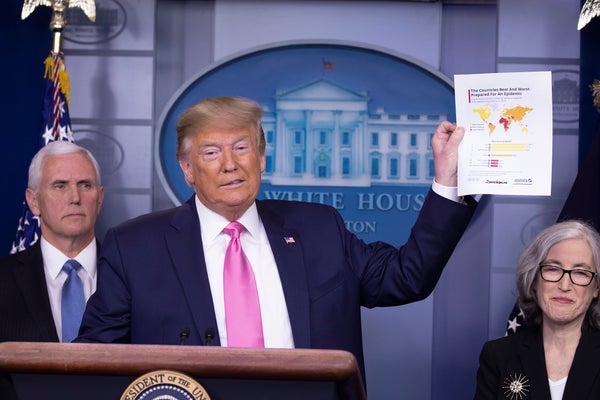
The problem was, Fauci's sober assessment of the threat from the virus was at odds with the official White House party line: that within a couple of days the number of cases in the United States would be "down to close to zero" and that "we're rapidly developing a vaccine" that will come to the rescue if the virus breaks out. So Fauci soon got word that he could not speak with the public unless authorized by the White House. Five scheduled appearances on Sunday shows: cancelled. Though Fauci insists that he's not muzzled, and has since made a few appearances in the media, his impact and influence are a fraction of what they would be if he were able to talk as freely as he usually could. Thus, Trump crossed the line into openly suppressing the voices of government scientists who might possibly contradict him.
On supporting science journalism
If you're enjoying this article, consider supporting our award-winning journalism by subscribing. By purchasing a subscription you are helping to ensure the future of impactful stories about the discoveries and ideas shaping our world today.
The word "openly" is important, because the attempt to stifle scientists' opinions has been going on for a long time, mostly behind the scenes. Trump had hardly been in office a few weeks before the reported memory holing began; soon government Web sites were apparently scrubbed of offensive terms such as "climate change." At the Centers for Disease Control—a key agency in dealing with COVID—scientists were blocked from speaking out. Just as Fauci can't speak to the press without asking permission, scientists at the CDC have been blocked from speaking to reporters—including “any or all correspondence with any member of the news media ... includ[ing] everything from formal interview requests to the most basic of data requests”—by press officers in Atlanta who seldom seem willing to grant such authorization.
The stage for Trump's play to stifle the voices of scientists was set before he was even a gleam in the GOP’s eye. For years, journalists have been complaining about press officers' blocking access to government scientists who have something important to say, even—especially—at the CDC. Other agencies, too; the FDA even went so far as to create an internal surveillance operation to silence what it deemed "defamatory"—read: embarrassing—information circulated by some of its scientists.
We've now entered a new ballgame. Before, we had desultory attempts to shut dissenters up before they could embarrass the administration; in more normal times, this was an annoyance rather than a major threat to democracy. However, now we must face the fact that we're seeing a serious, terrifying, full-scale government misinformation campaign—the bureaucratic suppression of scientific truth in favor of politically acceptable fiction—in action. And at a moment when our society needs reliable scientific information the most, the most dangerous source of misinformation in the U.S. has become our own president.