
This article was published in Scientific American’s former blog network and reflects the views of the author, not necessarily those of Scientific American
Staring up as cascades of colorful light bloom noisily from the dark sky—that's how many Americans will conclude their Independence Day. Behind the pretty image, however, fireworks rely on basic physical and chemical principles. So just how do fireworks work? Various corners of the internet, including this website, have tackled the topic before.
In 2003, Scientific American published "What are the physical and chemical changes that occur in fireworks?", an Ask the Experts feature by University of Missouri at Rolla professor Paul Nicholas Worsey.
The most common type of display firework is the aerial shell, which is fired from a mortar tube. These fireworks typically have four components: a lift charge, a time-delay fuse, a breaking charge and a light/effect generator. The lift charge is generally black powder, a compound that burns rapidly and propels the shell from its tube. The lift charge also ignites the delay fuse when it fires. The delay fuse is usually a black powder fuse with a delay of a few seconds, and it is designed to ignite the break charge when the shell reaches the appropriate height. The purpose of the break charge, which sits at the center of the lofted shell, is to explode, thereby igniting and scattering the shell's contents. This break charge is generally finer-grained black powder than the lift charge and more highly confined, which causes the shell to explode. The payload of the shell usually comprises small spherical pellets of pyrotechnic composition designed to generate light.
On supporting science journalism
If you're enjoying this article, consider supporting our award-winning journalism by subscribing. By purchasing a subscription you are helping to ensure the future of impactful stories about the discoveries and ideas shaping our world today.
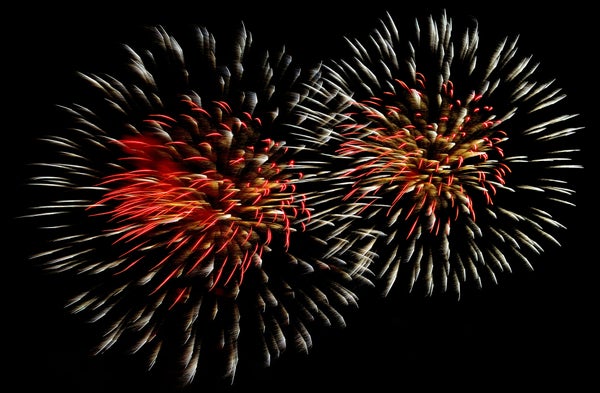
Lighting the lift charge sends the aerial shell rocketing into the air and triggers the time-delay fuse, which ignites the break charge so the shell explodes in midair, shooting the payload of light-generating pellets, sometimes called star pellets, out in a pattern. For example, to create a five-pointed star, the pellets are arranged in a star pattern within the shell.
Prefer a visual guide? PBS's NOVA has the page Anatomy of a Firework, where depictions of aerial shells' innards accompany discussions of their composition, in addition to NOVA's listing of other fireworks resources available both on and offline.
NOVA's discussion includes multi-break shells, which include several different sections that explode in a sequence. Multi-break fireworks even get a visual guide at HowStuffWorks.com. In another visual, Marshall Brain provides a quick-and-dirty explanation of the makeup of aerial shells in the video How Fireworks Work.
For more details on how star pellets' chemical composition creates explosions of color, try the fireworks page on the "Science is Fun" website of Bassam Z. Shakhashiri, a University of Wisconsin - Madison professor of chemistry.
The colors are produced by heating metal salts, such as calcium chloride or sodium nitrate, that emit characteristic colors. The atoms of each element absorb energy and release it as light of specific colors. The energy absorbed by an atom rearranges its electrons from their lowest-energy state, called the ground state, up to a higher-energy state, called an excited state. The excess energy of the excited state is emitted as light, as the electrons descend to lower-energy states, and ultimately, the ground state. The amount of energy emitted is characteristic of the element, and the amount of energy determines the color of the light emitted. For example, when sodium nitrate is heated, the electrons of the sodium atoms absorb heat energy and become excited. This high-energy excited state does not last for long, and the excited electrons of the sodium atom quickly release their energy, about 200 kJ/mol, which is the energy of yellow light.
Science blogger and San Jose State University professor of philosophy Janet D. Stemwedel discusses the chemicals behind each color, elaborating on a Chemical and Engineering News article by Elizabeth Wilson, "What's That Stuff? Fireworks."
For a visual aid, check out the American Chemical Society (ACS) video in which John Conkling, a Washington College adjunct professor of chemistry, discusses the various chemicals that go into fireworks to create explosions and flashes of color.
But blowing up chemicals has an environmentally negative side-effect, as Scientific American online reporter Katharine Harmon discussed in a 2009 blog post, "Bombs bursting in air: What's in those Fourth of July fireworks, anyway?"
Waterways, often selected as launching sites to help decrease fire risk, show a spike in perchlorates (up from .08 to 44.2 micrograms per liter) after Fourth of July, a 2007 U.S. Environmental Protection Agency (EPA) study found. Perchlorates, which are used to help the fireworks’ fuel burn, were named in an EPA health advisory earlier this year (which recommended a maximum of 15 micrograms per liter of drinking water), as they have been linked to disruption of the thyroid gland.
On top of perchlorates, some of the color-creating chemicals in fireworks can harm health. Alternative chemicals, however, may save the day. For example, in an April article in Nature, "Cleaner, greener fireworks," James Mitchell Crow reported that boron carbide may be a viable, environmentally friendlier replacement for barium-based compounds, used to make green light.
Bonus: The ACS has made other "Chemistry of" features, including last year's Fourth of July special, The Chemistry of Barbecue.