
This article was published in Scientific American’s former blog network and reflects the views of the author, not necessarily those of Scientific American
Moving to clean energy technologies could benefit public health today and save us billions of dollars, according to a new report from The Lancet medical journal.
In “Health and Climate Change: policy responses to protect public health” a group of European and Chinese academics built upon a 2009 report in The Lancet that outlined the expected public health impacts of climate change (full disclosure – the group of academics includes the author of this post). These impacts include increasing instances of respiratory, cardiovascular, and vector-borne diseases as well as undernutrition and mental health challenges.
On supporting science journalism
If you're enjoying this article, consider supporting our award-winning journalism by subscribing. By purchasing a subscription you are helping to ensure the future of impactful stories about the discoveries and ideas shaping our world today.
But, even more immediately, the authors discuss how moving away from carbon-intensive energy technologies could improve public health today by reducing other types of air pollution including particulate matter (PM) and nitrogen oxides (NOx).
The core of this discussion lies on the fact that energy technologies that produce greenhouse gases also often produce these other air pollutants simultaneously. For example, diesel and gasoline vehicles, coal power plants, biomass (for example, wood and charcoal) for cooking, and many industrial processes (for example, mining, cement manufacturing, and smelting) all produce both carbon dioxide and particulate matter (PM).
These other air pollutants lead to higher rates of illness and premature death in exposed populations.
In the United Kingdom, air pollution from coal power plants is responsible for an estimated £3.1 billion per year in added health costs to treat conditions including lung cancer and chronic bronchitis. Overall, air pollution from the UK’s power sector is responsible for approximately 3,800 premature deaths each year due to respiratory disease alone. Each year, pollution from the UK’s transportation sector leads to 7,500 premature deaths across the country.
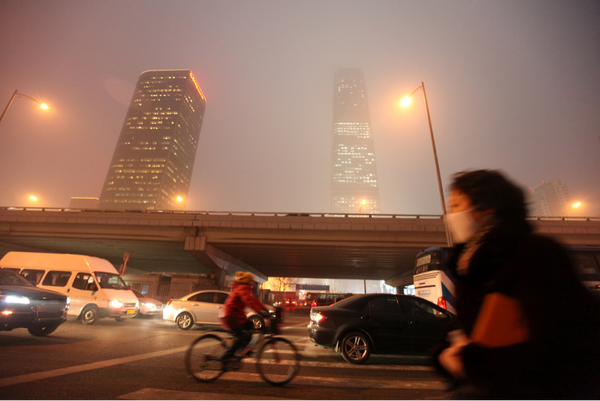
Air pollution in China has an even more dramatic impact on human health. In 2010, air pollution led to an estimated 1.2 million premature deaths and the loss of 25 million healthy years of life. These premature deaths correspond to economic losses of up to USD 1.4 trillion. The average person in China will lose over 3 years (40 months) of life due to fine particulate matter (PM2.5) air pollution even though the country already spends an estimated 0.37% of its GDP on cleaning the air.
Countries could quickly and economically reduce air pollution and its direct impacts on public health by transitioning to low-carbon energy technologies, according to The Lancet report. For example, a combination of more fuel efficient vehicles and increasing amounts of walking and cycling in the U.K.’s urban areas could lead to a net savings of more than £15 billion by 2030 to the country’s social security and healthcare systems.
The overall message from the new Lancet report is that climate change mitigation could be the greatest global health opportunity of the 21st century. Much of this opportunity lies in avoiding future negative health impacts from climate change. However, an arguably stronger – and certainly more immediate - case lies in the immediate benefits resulting from lower levels of air pollution as we move to low-carbon energy technologies.
Related articles:
- Air Pollution Linked to Significant Decrease in Life Expectancy (link)
- Should Public Transport Be Free In Cities With Bad Air Quality? (link)
- Transportation Changes Quickly Cleaned Up the Air – Now what? (link)
- Should the British Expand Heathrow Airport? (link)
- The Cyclic Nature of Crazy Bad Air Pollution and Fuel Transitions (link)
- Less Coal and Better Air Quality: China’s New Normal? (link)