
This article was published in Scientific American’s former blog network and reflects the views of the author, not necessarily those of Scientific American
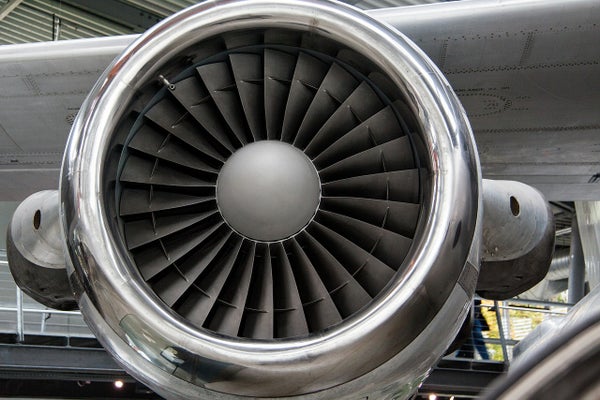
Researchers at The Ohio State University have discovered a way to improve the performance of turbine engines, including those used for transportation and in electricity generation.
In their new article in Nature Communications, these scientists present a new technique for dramatically reducing microscopic defects in a class of superalloys used in these turbines. According to Materials Science and Engineering Professor Michael Mills who led this research project, these reductions can improve the overall performance of turbine engines, lowering their fuel use and decreasing emissions.
This new technique is called “phase transformation strengthening” and involves the tailoring of an alloy’s composition in order to prevent the formation of microscopic defects (called “nano twins”) within the alloy. According to the lead author of this new paper, Dr. Timothy Smith:
On supporting science journalism
If you're enjoying this article, consider supporting our award-winning journalism by subscribing. By purchasing a subscription you are helping to ensure the future of impactful stories about the discoveries and ideas shaping our world today.
“when the amount of titanium, tantalum, and niobium in the alloy was increased, while decreasing cobalt and chromium, we could actually strengthen the region around the faults and prevent the fault from widening into a nano twin.”
By using this process, Smith and his fellow researchers were able to reduce the formation of “nano twin” defects by half. In turn, these alloys can be exposed to higher temperatures and pressures without deforming.
Smith completed this research during his PhD program at The Ohio State and is now working as a research materials engineer at NASA Glenn Research Center. His co-authors included Robert Williams, assistant director of CEMAS; Wolfgang Windl, Professor of Materials Science and Engineering; Hamish Fraser, Ohio Eminent Scholar and Professor of Materials Science and Engineering; and doctoral students Bryan Esser and Nikolas Antolin, all of Ohio State; Anna Carlsson of FEI/Thermo Fisher Scientific; and Andrew Wessman of GE.
Reference: Smith, T. M., Esser, B. D., Antolin, N., Carlsson, A., Williams, R. E. A., Wessman, A., Hanlon, T., Fraser, H. L., Windl, W., McComb, D. W. and Mills, M. J. (2016) ‘Phase transformation strengthening of high-temperature superalloys’, Nature Communications. The Author(s), 7, p. 13434. Available at: http://dx.doi.org/10.1038/ncomms13434.