
This article was published in Scientific American’s former blog network and reflects the views of the author, not necessarily those of Scientific American
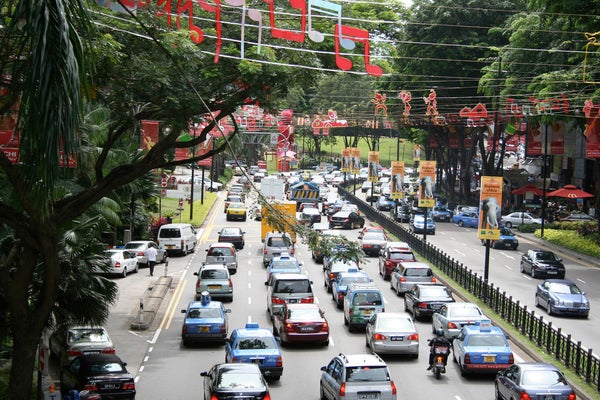
This month, Singapore’s Land Transport Authority (LTA) announced that it will ban additional cars from its roads in an effort to control traffic. This ban will take effect in February 2018.
With a total land area of just under 278 square miles, Singapore is smaller than New York City. Roads already occupy 12% of the city-state’s total land area, which has a population of just over 5.6 million people.
According to the LTA, due to these “land constraints and competing needs, there is limited scope for further expansion of the road network” in Singapore. This is why the LTA was already restricting the number of vehicles that could be registered in Singapore to a maximum growth rate of 0.25% per year. The new ban drops this growth rate to 0% for cars and motorcycles. Buses and commercial goods vehicles will still be restricted to the previous 0.25% limit.
On supporting science journalism
If you're enjoying this article, consider supporting our award-winning journalism by subscribing. By purchasing a subscription you are helping to ensure the future of impactful stories about the discoveries and ideas shaping our world today.
Simultaneously, the LTA announced that it would be doubling-down on investment in Singapore’s public transportation system. In their announcement, the LTA highlighted recent expansions in its bus and rail network, stating that:
“Over the past six years, we have expanded our rail network significantly, growing the rail network length by 30% and adding a total of 41 new stations. Through the $1 billion Bus Service Enhancement Programme and Bus Contracting Model, we have added new routes and injected greater capacity into the bus network while raising service levels. The Government will continue to invest $20 billion in new rail infrastructure, $4 billion to renew, upgrade and expand rail operating assets, and another $4 billion in bus contracting subsidies over the next five years to improve public transport.
Singapore is already one of the most expensive places to own a car in the world due to its restrictions on vehicle ownership. In order to register a car in Singapore, owners must buy a “Certificate of Entitlement” (COE). At an offering of these permits earlier this month, a single permit for a small car cost just over S$41,617 (about 30,000 USD at current exchange rates).
That being said, the LTA does not believe that the tighter restrictions will significantly impact the availability of COEs, as their availability is “determined largely by the number of vehicle deregistrations” in Singapore.