
This article was published in Scientific American’s former blog network and reflects the views of the author, not necessarily those of Scientific American
Want to boil some water? Forget the teapot and pick up some bubble wrap, says a research team including MIT graduate student George Ni and Professor Gang Chen.
In their new paper published in Nature Energy, Ni and his co-authors describe their design for a low-tech “solar vapor generator” that can boil water and generate steam using ambient sunlight without the use of mirrors or expensive lenses to concentrate the sun.
Their design builds on a previous solar-absorbing structure developed by their team in 2014, which included a floating, sponge-like material created using graphite and carbon foam. In this previous design, the researchers were able to convert 85% of the incoming sunlight into steam. This conversion efficiency meant that they had to use artificial sunlight that was 10 times the intensity of the sunlight you find outside in order to generate enough steam.
On supporting science journalism
If you're enjoying this article, consider supporting our award-winning journalism by subscribing. By purchasing a subscription you are helping to ensure the future of impactful stories about the discoveries and ideas shaping our world today.
The key challenge at this step in the design process was that, while the sponge-like material was absorbing sunlight pretty well, it was also radiating heat back into the surrounding environment. In turn, the team started looking at ways to minimize heat loss from their system.
They would soon settle on using a thin copper plate coated with a spectrally-selective absorber material that could both absorb sunlight and trap heat. The copper chosen for its heat-conducting abilities. When combined with a thin film blue, metallic-like absorber material the plate limited the amount of heat that was radiated out into the environment.
But, the structure didn’t eliminate the heat that was escaping from the system via convection as air passed over the surface.
According to Chen, at this point “I kept asking myself, ‘Can we basically boil water on a rooftop, in normal conditions, without optically concentrating the sunlight?”
Inspiration would soon strike from a somewhat unlikely source – at the time, Chen’s 16-year old daughter was making a greenhouse for a science fair project. Using simple materials, including bubble wrap, Chen says that his daughter “was able to heat [the greenhouse] to 160 degrees Fahrenheit, in winter!”
Subsequently, Chen proposed to Ni that they use this cheap and commonly available material to trap heat from the sun in its insulating bubbles. According to Ni:
“I was very skeptical of the idea at first…I thought it was not a high-performance material. But we tried the clearer bubble wrap with bigger bubbles for more air trapping effect, and it turns out, it works. Now because of this bubble wrap, we don’t need mirrors to concentrate the sun.”
At this point, the new system design consisted of:
a sponge-like material created using graphite and carbon
a thin, blue, metallic-like film that is commonly used in solar water heaters and can both absorb sunlight and trap heat
bubble wrap - the clearer kind, with big bubbles
.jpg?w=2000)
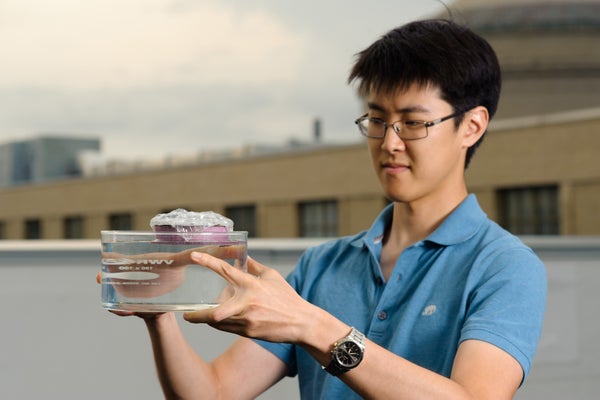
Bubble wrap, combined with a selective absorber, keeps heat from escaping the surface of the sponge. Credit: GEORGE Ni
After drilling a single hole through the structure and placing the system in water, the researchers found that the water would creep up the hold and be heated into steam. Om fact, the researchers found that their new design could heat up water to 100 degrees Celsius “even on relatively cool, overcast days”.
The researchers hope that this low-tech design could be used to provide an inexpensive option for applications ranging from the large scale (e.g. desalination and wastewater treatment) to smaller applications (e.g. residential water heating).