
This article was published in Scientific American’s former blog network and reflects the views of the author, not necessarily those of Scientific American
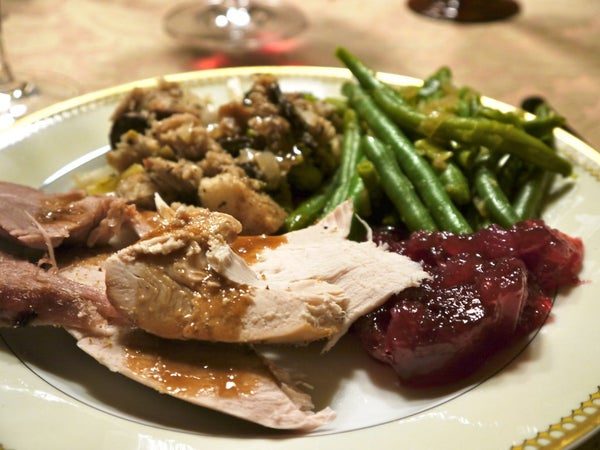
There are many reasons to not let those Thanksgiving leftovers go to waste, including the energy savings.
According to scientists from the University of Texas at Austin, the United States could save roughly 2 percent of its total energy consumption each year if it could significantly reduce or eliminate its food waste.
Every day, the average American household throws away a pound and a half of food and the energy embedded within this food. According to research presented by University of Texas Professor Dr. Michael Webber and his former student researcher Amanda Cuellar***, these pounds of wasted food add up to the energy equivalent of throwing 350 million barrels of oil each year.
On supporting science journalism
If you're enjoying this article, consider supporting our award-winning journalism by subscribing. By purchasing a subscription you are helping to ensure the future of impactful stories about the discoveries and ideas shaping our world today.
To put it in perspective, this wasted energy is about twice the amount of energy that Switzerland consumes in an entire year. According to Webber and Cuellar:
“The amount of energy embedded in the food we throw away is more than all the energy we get from the corn ethanol we produce in a year, so this is a big number and it’s a big, underutilized policy option for us to consider.”
One can read the entire report by Webber and Cuellar at this link.
Reference:
1. Cuellar, Amanda and M.E. Webber. Wasted Food, Wasted ENergy: The Embedded Energy in Food Waste in the United States. Environ. Sci. Technol., 2010, 44 (16), pp 6464–6469 DOI: 10.1021/es100310d Publication Date (Web): July 21, 2010
***This research was previously discussed on Plugged In on May 16, 2012.