
This article was published in Scientific American’s former blog network and reflects the views of the author, not necessarily those of Scientific American
“Wherever you are on World Toilet Day, make it about toilets.” So recommends the World Toilet Day website. Today, I’m writing about math on this blog, so I’m going to make it about toilets. Or at least about the rooms they inhabit.
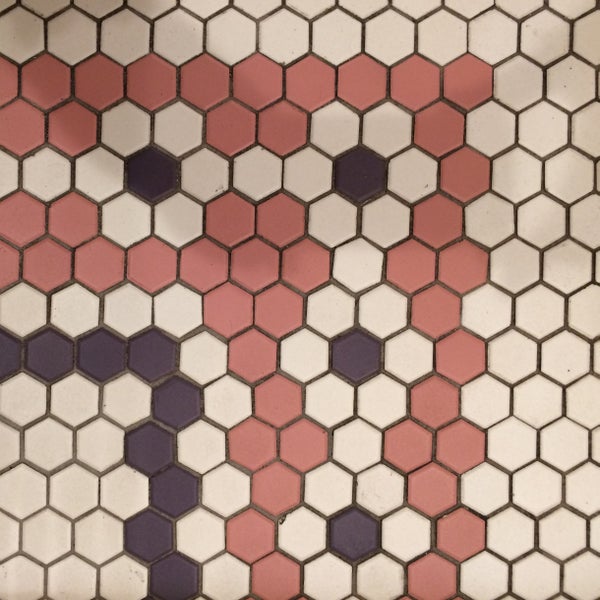
On a recent trip out to breakfast, I went to the restroom. When I got back to the table, I grabbed my phone and went to the bathroom again. I was a little worried about looking like a creep, but I took the risk so I could document a cool tiling pattern on the ground, which you can see at the top of this post. I think you'll agree it was worth going back for.
A lot of the #foundmath photos I post on Instagram come from bathrooms. For example, I feel like at least 90% of indoor hexagonal tilings occur in bathrooms.
On supporting science journalism
If you're enjoying this article, consider supporting our award-winning journalism by subscribing. By purchasing a subscription you are helping to ensure the future of impactful stories about the discoveries and ideas shaping our world today.

Sometimes hexagons are reflected in quadrilaterals! Credit: Evelyn Lamb
And I’m always happy to find truncated squares.

Credit: Evelyn Lamb
Even squares are more interesting in bathrooms.

It's probably cheating to include a picture from a science museum, but this bathroom tiling from the Exploratorium was too good not to include. Credit: Evelyn Lamb
I believe rectangles are underrated, and bathroom tilings are some good evidence to prove my point.
.jpg?w=1350)
My brother's house is a festival of interesting rectangular bathroom tilings. Credit: Evelyn Lamb
What is it about bathrooms that makes them so mathematically fertile? Kitchens and bathrooms tend to be tiled more often than other rooms, which certainly helps. That makes sense: there are lots of liquids and messes in both rooms, and tile is easy to clean. Kitchen tilings can be pretty and interesting, but why are bathrooms more likely to have mathematical designs?
Is it because bathrooms are small, and we don’t spend as much time in them, so we don’t mind a more assertive pattern? Is it because we feel that the bathroom has something of a captive audience, and we want to have a visually stimulating environment? Is it because we don’t think geometric designs are sophisticated enough for kitchens? Does viewing hexagons subconsciously promote quick, easy elimination? (Sadly, a Google search for "Do hexagons help you poop" provides little illumination on this topic.)
Whatever the reason, a nice mathematical pattern is always a pleasant addition to a trip to the restroom. Have you seen any good patterns in the
bathroommathroom lately? I've been sharing mine on Twitter and Instagram with the hashtags #bathroommath and #bathroommathroom. Join me.
To those of us with ready access to clean facilities in which to dispose of our various bodily wastes, World Toilet Day sounds funny, but it’s a serious topic. The day was established by the UN in 2013 to raise awareness (and money, which produces more tangible progress than awareness does) of the fact that billions of our fellow humans lack access to sanitary toilets. After you’ve admired the tiling patterns and done whatever else you need to do in the bathroom, head over to the World Toilet Day website to learn more.