
This article was published in Scientific American’s former blog network and reflects the views of the author, not necessarily those of Scientific American
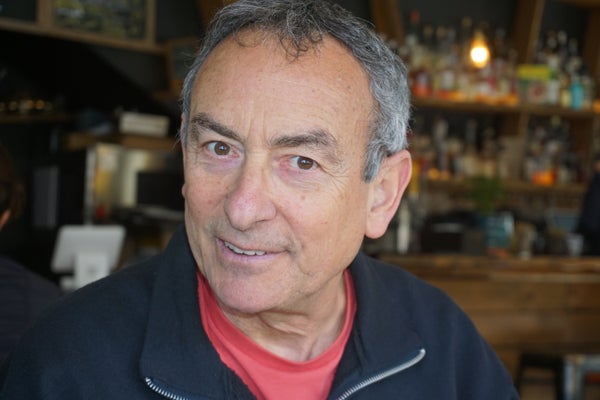
In today’s episode of our podcast My Favorite Theorem, Kevin Knudson and I were happy to welcome Ken Ribet on the show. Dr. Ribet is a math professor at the University of California Berkeley and president of the American Mathematical Society. You can listen to the episode here or at kpknudson.com, where there is also a transcript.
Dr. Ribet picked a classic as his favorite theorem: the infinitude of primes. A prime number is a number that has exactly two distinct divisors: itself and 1. The first few primes are 2, 3, 5, 7, and 11. But how long does that list go? Ancient Greek mathematicians knew the list never ended, and many students have experienced one of their first big “aha” moments in math figuring out for themselves why the list cannot end.
On supporting science journalism
If you're enjoying this article, consider supporting our award-winning journalism by subscribing. By purchasing a subscription you are helping to ensure the future of impactful stories about the discoveries and ideas shaping our world today.
Dr. Ribet shared three of his favorite proofs of the infinitude of primes. The first is Euclid’s original proofs, which is also one of my favorite proofs. He mentions the Euclid-Mullin sequence, which you can find on Wikipedia and the Online Encyclopedia of Integer Sequences. The second uses Fermat numbers, which have the form 22n+1. You can read more about that proof here. The third was completely new to me. Dr. Ribet learned about it from the book A Classical Introduction to Modern Number Theory by Kenneth Ireland and Michael Rosen. The proof is also in an American Mathematical Monthly article by Eckford Cohen called “Legendre’s Identity.”
In each episode of the podcast, we ask our guest to pair their theorem with food, beverage, art, music, or other delight in life. In addition to several proofs, Dr. Ribet shared several potential pairings for the theorem, eventually converging on Hammond Song by The Roches. You’ll have to listen to the episode to hear about his personal connection to the music and why he chose it.
You can find more information about the mathematicians and theorems featured in this podcast, along with other delightful mathematical treats, at kpknudson.com and here at Roots of Unity. A transcript is available here. You can subscribe to and review the podcast on iTunes and other podcast delivery systems. We love to hear from our listeners, so please drop us a line at myfavoritetheorem@gmail.com. Kevin Knudson’s handle on Twitter is @niveknosdunk, and mine is @evelynjlamb. The show itself also has a Twitter feed: @myfavethm and a Facebook page. Join us next time to learn another fascinating piece of mathematics.
Previously on My Favorite Theorem:
Episode 0: Your hosts' favorite theorems Episode 1: Amie Wilkinson’s favorite theorem Episode 2: Dave Richeson's favorite theorem Episode 3: Emille Davie Lawrence's favorite theorem Episode 4: Jordan Ellenberg's favorite theorem Episode 5: Dusa McDuff's favorite theorem Episode 6: Eriko Hironaka's favorite theorem Episode 7: Henry Fowler's favorite theorem Episode 8: Justin Curry's favorite theorem Episode 9: Ami Radunskaya's favorite theorem Episode 10: Mohamed Omar's favorite theorem Episode 11: Jeanne Clelland's favorite theorem Episode 12: Candice Price's favorite theorem Episode 13: Patrick Honner's favorite theorem Episode 14: Laura Taalman's favorite theorem Episode 15: Federico Ardila's favorite theorem Episode 16: Jayadev Athreya's favorite theorem Episode 17: Nalini Joshi's favorite theorem Episode 18: John Urschel's favorite theorem Episode 19: Emily Riehl's favorite theorem Episode 20: Francis Su's favorite theorem Episode 21: Jana Rordiguez Hertz's favorite theorem