
This article was published in Scientific American’s former blog network and reflects the views of the author, not necessarily those of Scientific American
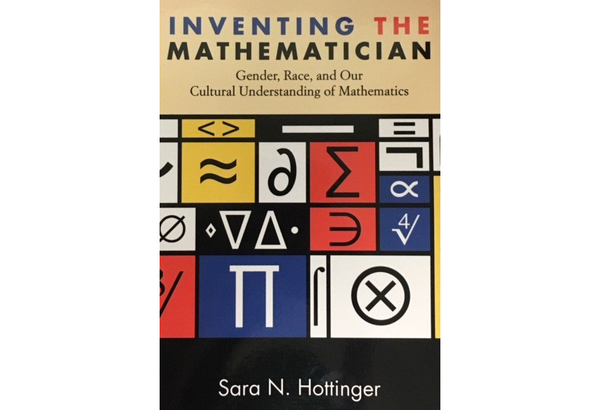
It’s no secret that math has gender and race problems. White women and black, Native, and Latinx people are vastly underrepresented as faculty members in math departments. Asked to picture a mathematician, most people probably default to a white man, perhaps eccentrically dressed and socially awkward. Sara N. Hottinger’s 2016 book Inventing the Mathematician: Gender, Race, and Our Cultural Understanding of Mathematics (SUNY Press) takes a look at how our culture constructs mathematical knowing and who mathematicians are. Hottinger, now a dean and professor of women's and gender studies at Coastal Carolina University, was a double major in mathematics and women’s studies in college and went to graduate school in feminist studies instead of mathematics in part because she believed, in spite of her mathematics successes in college, that she would not be able to be successful in that field.
The four main chapters of the book are about the incompatibility of femininity with mathematical achievement, the construction of white men as normative in math history texts, the use of portraits of mathematicians in math and math history books, and the field of ethnomathematics.
Hottinger’s chapter on femininity and mathematics focuses on how math textbooks do or do not use stereotypically feminine examples to illustrate mathematics. In general, school math textbooks use gender neutral examples (though as Hottinger points out, even the idea of gender neutrality is problematic because of the way our culture tends to default to masculinity). There are some unfortunate examples of sexism in popular math textbooks—female students in problems being passive while male students are active, for example—but I especially appreciated her analysis of the cultural response to Danica McKellar’s math books, which are written for girls and use explicitly feminine examples. I must admit I have had some of the negative thoughts Hottinger mentions about McKellar’s books. “Ugh, why do these examples have to be about makeup and fashion?” Femininity is devalued in our society. Makeup and fashion are seen as frivolous. I have absorbed those messages (and I’m working on losing them and becoming less sexist). Responses like mine and the way the media treats McKellar’s books, Hottinger writes, show how incompatible femininity is with mathematical achievement.
On supporting science journalism
If you're enjoying this article, consider supporting our award-winning journalism by subscribing. By purchasing a subscription you are helping to ensure the future of impactful stories about the discoveries and ideas shaping our world today.
The chapters on race and gender in historical accounts of mathematics and in portraits of mathematicians both continued I must admit that at first I was skeptical about the chapter about mathematical portraiture, but my skepticism evaporated when I saw Émilie Du Châtelet staring at me. (I wrote a little bit about what her portrait meant to me last November.) As much as Hottinger’s writing in that chapter, my own reaction to the picture made me realize she was right about how important those portraits can be.
The most difficult chapter for me was the chapter on ethnomathematics. The field of ethnomathematics is relatively new. It seeks to study and contextualize mathematics done outside of traditional Western mathematics and to take Western mathematics off its pedestal and place it as only one among many mathematical ways of knowing. Another purpose of ethnomathematics is educational, finding culturally relevant and diverse ways of doing mathematics in the classroom. Hottinger writes that despite those intentions, ethnomathematics in practice can reinforce Western mathematics as the default and construct the particular ethnomathematics in question as an Other. One of Hottinger’s central themes, not just of this chapter but of the book as a whole, is the fact that the gendered and racialized picture of mathematicians is crucial not just to the way Western mathematics is viewed but to the construction of Western culture more broadly. Knowing that, it seems difficult to move forward with ethnomathematics that doesn’t succumb to some of the pitfalls she identifies, though she does offer some examples of ethnomathematics done better and suggestions for improvement.
Inventing the Mathematician is thought-provoking and challenging. It raised more questions than answers for me, and it will help me be a careful consumer and creator of writing about mathematics and mathematicians.