
This article was published in Scientific American’s former blog network and reflects the views of the author, not necessarily those of Scientific American
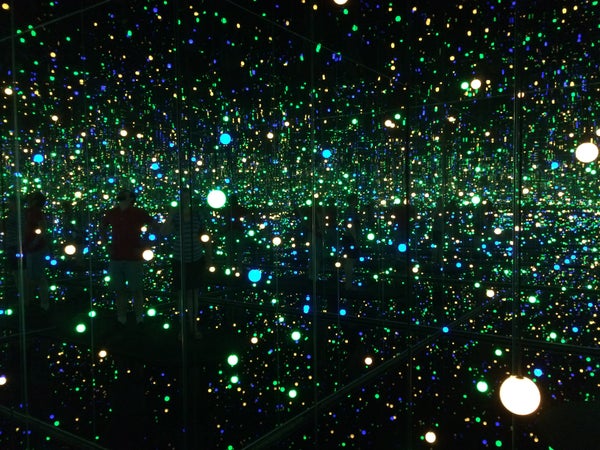
Earlier this month, my travels took me and my spouse to Copenhagen. While trying to get the most out of an 8-zone transit pass, we took the train to the Louisiana Museum of Modern Art, which has a beautiful setting, an affectionate resident kitty, and gorgeous views across Øresund to Sweden. Unbeknownst to us, it also has an art installation that lets you feel like you’re visiting a three-torus.

A first glimpse into a three-torus. Credit: Evelyn Lamb
I’ve written about the three-torus here before. It’s the three-dimensional version of what happens when you go off the edge of the screen in some video games and pop up on the other side. One way to imagine it is as a cube where the top is glued to the bottom, the front is glued to the back, and the right side is glued to the left side. If you stomp your foot and sink into the ground, your feet will start dangling above you. If you stick your left arm through the left wall, it will come out of the right wall at you.
On supporting science journalism
If you're enjoying this article, consider supporting our award-winning journalism by subscribing. By purchasing a subscription you are helping to ensure the future of impactful stories about the discoveries and ideas shaping our world today.
In my previous post about the three-torus, I talked about how disorienting it would be to live in a three-torus, or at least in a small one where you could see many copies of yourself at close range. When I stepped into Yayoi Kusama’s installation at Louisiana, Gleaming Lights of the Souls, I got to feel that disorientation firsthand.* But I also felt that I had sold the three-torus short in my first post. This three-torus was disorienting, but it was even more beautiful.

Credit: Evelyn Lamb
Gleaming Lights of the Souls is a small room with mirrors on the walls and ceiling and a shallow pool of water on the floor. Hanging from the ceiling are hundreds of lights whose colors change over time. To experience the art, you stand on a platform in the middle of the room and look around. Amid the lights large and small, you can see many different reflections of yourself pointing in different directions.

A panorama is also a time-lapse. Credit: Evelyn Lamb
When I wrote about the three-torus in 2015, I described it as a narcissist’s dream. The realization of this mathematical space in the mirrored room of Gleaming Lights of the Souls forces you to gaze on endless copies of yourself. Any picture you take will automatically be a selfie. Personally, I felt a tension between the otherworldly beauty of the colorful lights and my tendency to focus on my own reflection.

Gleaming Lights of the Souls invites reflection. Credit: Evelyn Lamb
When I got home and started learning more about Kusama, I was interested to see that both narcissism and infinity are recurring themes in her other work.
I go to art museums because I love art, but I don’t check my mathematical self at the door. And I wouldn’t want to. Mathematics influences the way I approach art, and it often enriches my experience. I was not familiar with Kusama before stepping into her three-torus. I’m glad a piece of art that lent itself to mathematical interpretation grabbed my attention and introduced me to this fascinating artist.
*A question from someone on Twitter convinced me I should elaborate a little bit on the details of how this mirrored room is or is not a three-torus. If you sit down and think carefully about the topology, you'll see there's a little more going on in Gleaming Lights of the Souls than just the three-torus. In the three-torus, you'd see the back of your head if you looked straight into one of the walls, but you wouldn't see a reflection of your face. In a mirrored room, if you get just the right angle, you can see a reflection of the back of your head in front of you in the correct orientation, but you also see your reflected face, so it's sort of like you're looking at a couple of different topological spaces at the same time. The three-torus is there, but there's some other stuff going on too. If you've studied a little topology, you might have fun thinking through the details.