
This article was published in Scientific American’s former blog network and reflects the views of the author, not necessarily those of Scientific American
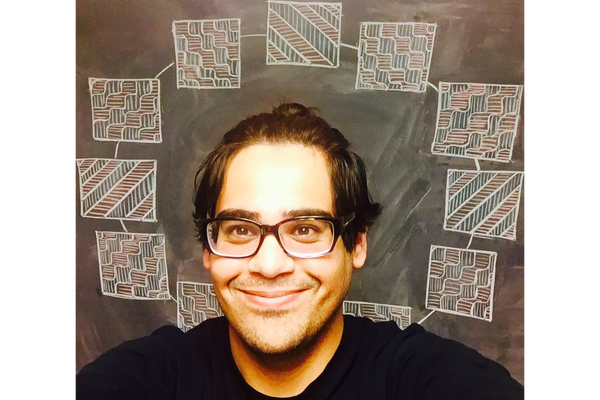
In this episode of our podcast My Favorite Theorem, my cohost Kevin Knudson and I were happy to talk with Vidit Nanda. At the time we recorded, he was visiting the Institute for Advanced Study in Princeton, but he is back in England, where he is a research fellow at the University of Oxford and the Alan Turing Institute in London, which from his description sounds like a very inspiring place to work. You can listen to the episode here or at kpknudson.com, where there is also a transcript.
After much deliberation, Dr. Nanda decided to declare Banach’s fixed-point theorem his favorite. Like the Brouwer fixed-point theorem, which Francis Su told us about a few episodes ago, the Banach fixed-point theorem, also known as the contraction mapping principle, is about functions that take a space to itself—for example, a function like f(x)=x/2, where x can be any real number.
On supporting science journalism
If you're enjoying this article, consider supporting our award-winning journalism by subscribing. By purchasing a subscription you are helping to ensure the future of impactful stories about the discoveries and ideas shaping our world today.
The theorem says that, assuming some technical properties hold, if the function contracts distances, then it has a fixed point, meaning a point that is taken to itself by the function. The contraction requirement is basically what it sounds like: if you put any two numbers x and y into the function f, the distance between the outputs f(x) and f(y) is smaller than the distance between the inputs x and y. The function f(x)=x/2 is a contraction map, and its fixed point is 0 because 0=0/2. The square root function, for inputs greater than 1/4, is another, slightly more exciting, example.
Dr. Nanda talked about some of the reasons he likes the Banach fixed-point theorem (one reason involves mashing buttons on a calculator), and then it was time for a pairing! In each episode, we invite our guest to pair their theorem with something: food, beverage, art, music, anything that seems like a good match for their theorem. Dr. Nanda chose pizza, which is objectively the best food. You’ll have to listen to the episode to find out what toppings he chose and why pizza is such a good accompaniment to the Banach fixed-point theorem.
You can find Dr. Nanda on his website or Twitter. You can find more information about the mathematicians and theorems featured in this podcast, along with other delightful mathematical treats, at kpknudson.com and here at Roots of Unity. A transcript is available here. You can subscribe to and review the podcast on iTunes and other podcast delivery systems. We love to hear from our listeners, so please drop us a line at myfavoritetheorem@gmail.com. Kevin Knudson’s handle on Twitter is @niveknosdunk, and mine is @evelynjlamb. The show itself also has a Twitter feed: @myfavethm and a Facebook page. Join us next time to learn another fascinating piece of mathematics.
Previously on My Favorite Theorem:
Episode 0: Your hosts' favorite theorems Episode 1: Amie Wilkinson’s favorite theorem Episode 2: Dave Richeson's favorite theorem Episode 3: Emille Davie Lawrence's favorite theorem Episode 4: Jordan Ellenberg's favorite theorem Episode 5: Dusa McDuff's favorite theorem Episode 6: Eriko Hironaka's favorite theorem Episode 7: Henry Fowler's favorite theorem Episode 8: Justin Curry's favorite theorem Episode 9: Ami Radunskaya's favorite theorem Episode 10: Mohamed Omar's favorite theorem Episode 11: Jeanne Clelland's favorite theorem Episode 12: Candice Price's favorite theorem Episode 13: Patrick Honner's favorite theorem Episode 14: Laura Taalman's favorite theorem Episode 15: Federico Ardila's favorite theorem Episode 16: Jayadev Athreya's favorite theorem Episode 17: Nalini Joshi's favorite theorem Episode 18: John Urschel's favorite theorem Episode 19: Emily Riehl's favorite theorem Episode 20: Francis Su's favorite theorem Episode 21: Jana Rordiguez Hertz's favorite theorem Episode 22: Ken Ribet's favorite theorem Episode 23: Ingrid Daubechies's favorite theorem