
This article was published in Scientific American’s former blog network and reflects the views of the author, not necessarily those of Scientific American
The eruption was eerily quiet in many places close by, but could be heard loud and clear over a hundred miles away. Chapter 15 tells the stories of those far away, who nonetheless got hints something major was up.
Chapter 15: Who's On First
Bruce Stoker was at Big Lake when a huge noise like thunder built to a roar like a sonic boom. It was powerful enough to bounce off the surrounding hills and actually rattled windows and slammed doors in the neighbors' cabin. They all came running out, saw nothing in the immediate area to explain the noise, and shrugged.
On supporting science journalism
If you're enjoying this article, consider supporting our award-winning journalism by subscribing. By purchasing a subscription you are helping to ensure the future of impactful stories about the discoveries and ideas shaping our world today.
Everyone (joking): Mount St. Helens, tee hee.
Mount St. Helens: Ermahgherd, you guys, I'm not joking!
***
The next section has some pretty comedic moments.
At the Washington Department of Emergency Services....
Jim Hall (calls Forest Service at Vancouver): Yeah, so we're about to take owners to Spirit Lake. How's the mountain?
Forest Service: It's a beautiful day in the neighborhood, a beautiful day for - Oh, wait, nevermind.
Reade Apgar (ham radio operator coordinator, phones DES): Hams say, Big explosion! Huge!
Jim Hall: Crap in a hat.
That poor dude knew there were people all up and down the Toutle River valley, and that things were about to get distinctly icky.
***
Governor Ray, visiting Emergency Services in Lacey, WA right after the eruption, saw that the phones were ringing off the hook and the place was severely understaffed, so she sat down and started taking calls. The very first call:
"To stop the eruption, sacrifice a virgin."
Thanks for the tip, big guy.
***
Exchange between State Patrol Sergeant Wick Elder and the dispatcher:
Dispatcher: "Sergeant! Sergeant! The mountain blew up. It disappeared!"
Sergent Elder: "How in hell can a mountain disappear?"
Mount St. Helens: That's a great question, actually! First, you start by building up mind-boggling amounts of pressure for two months. Then, suddenly remove the thing that's keeping that pressure contained. You know, kinda like shaking up the world's biggest champagne bottle and then taking your thumb off the cork. Easy-peasy!
***
Oh, my heck. There were so many fools driving up the road into the gargantuan ash cloud that the deputy on Highway 504 couldn't stop them all.
People: on a highway that only goes toward and away, go AWAY from the erupting volcano. Not toward. Away. As in run. The only possible reason to go toward is if you have to do that temporarily in order to get away, which wasn't the case here.
***
Chapter 15 ends with geologists and reporters gathering frantically to get information about the eruption, all of them hoping against hope that their colleagues on the mountain are still alive. But there's no way to find out, and work to do. They do it.
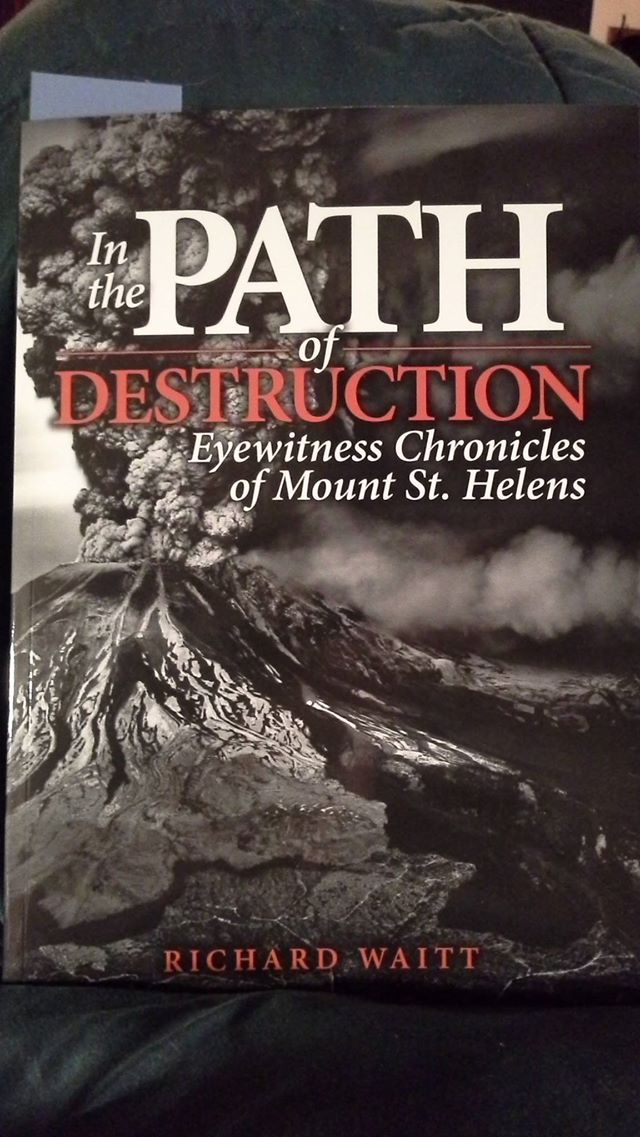
The full list of ITPOD posts is available here. If you want to forge ahead, you can pick up your own copy of In the Path of Destruction here. Purchases through that link help support my blogging, so thank you!