
This article was published in Scientific American’s former blog network and reflects the views of the author, not necessarily those of Scientific American
Welcome back to our live-blogging of Richard Waitt's excellent tome, In the Path of Destruction! Last time, Mount St. Helens finally unleashed all the force she'd been building. In this edition, we'll see how extra-exciting that made climbing her Cascade siblings.
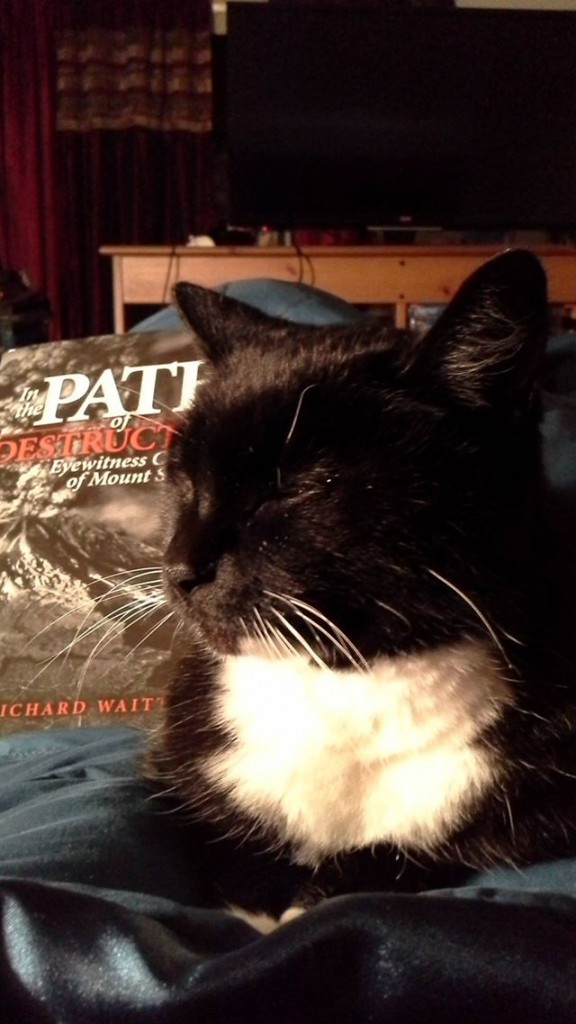
I had extra assistance for this edition. Say hello to my supervisor!

On supporting science journalism
If you're enjoying this article, consider supporting our award-winning journalism by subscribing. By purchasing a subscription you are helping to ensure the future of impactful stories about the discoveries and ideas shaping our world today.
Chapter 8: Cascade Peaks
So, imagine you're out climbing a local dormant volcano on a sweet, sunny May morning. The birds are singing. The woodland creatures are gamboling (or fleeing for cover, because OcrapOcrapHOOMAAANNNN!) All is well with your world.
Then you look toward Mount St. Helens in the normally serene distance, and...
Hikers: Bwah?!
Mount St. Helens: Ohai, I'm erupting! *KABOOM*
***
People on Mount Rainier watched the blast cloud rolling north over the ridges, then started digging foxholes in the snow. The eruption was 50 miles away to the south, but that cloud was so intimidating that people were seriously digging holes to protect themselves. Wow.
It did, of course, lose forward momentum and lift well before it got to them. They got to watch the eruption cloud, shot through with lighting, tower, and marvel for a while. Then the upper cloud advanced upon them....
Climbers (roping up): "Crap! Oh crap!" RUN AWAY!
As they descended Rainier, they were pelted with charred splinters, bark, and conifer needles. Ash rained down, becoming so thick they could barely see. By the time they reached their cars at Paradise, a quarter-inch of volcanic ash had fallen.
50 miles north. 50. Miles.
***
Note to skiers: if you want to de-wax your skis with a quickness, ski down a slope lightly dusted with fresh volcanic ash. You'll have those buggers de-waxed within a few hundred yards for sure.
***
Anybody else find it ironic that there was almost no ash in Ashford?
***
Don Lund watched the eruption from atop McClure Rocks. He watched the blast cloud roll over Shultz Creek - where he knew his colleague Ron Siebold was camping with his family.
I can't even imagine...
As the ash cloud reached his climbing party and they hiked down, he says the landscape looked like a negative image. Ash had "turned the snow dark and trees light." Volcanic eruptions can be incredibly eerie.
He snapped lots of photos. Some are published in the book. If you want to see how a volcanic eruption looks from a neighboring volcano, you absolutely should beg, borrow, or buy a copy! And if you buy through this link, you support my blogging, so extra awesome bonus!
***
So, if you think seeing the eruption from Mount Rainier was wild, wait til you hear from the folks on Mount Adams.
Jack Christiansen had reached the false summit at 11,800 feet at 8:30, just in time to see Mount St. Helens go boom. Ten minutes later, he found himself in a heatwave: the temps suddenly rose 30-40 degrees F. Five minutes after that, a dark cloud rolled up. When he held up his ice axe, he got a good sharp shock, even through his mitten.
As his party scrambled down, they ended up in a blizzard of sandy ash, charred pine cones, and branches as long as 16 inches. This, folks, is 33 miles east, not even in the line of the lateral blast.
My original plan to watch the next major Cascades eruption on teevee from many states away looks shinier by the moment...
***
This is interesting: the south side of Adams got hotter by about 30-40 degrees. But around the same time, the northwest side got cold as a chilly east wind blew towards St. Helens.
The northwest side also got more ash, much of it in BB-sized pellets, and cinders, along with branches charred on one side. Hikers had to find their way back to their tents by kneeling and finding their tracks by touch, and huge lightning bolts struck all around.
33 miles east, may I remind you.
Yoicks!
***
OMG, INTELLIGENT LIFE IN THE UNIVERSE!
Darryl Lloyd speaking of flying over Mount St. Helens in April: "Huge fractures north of summit suggested a coming collapse, so I stayed away."
***
Yeah, so, tree branches up to 3 feet long ended up stripped from Mount St. Helens’s forests and dumped on Mount Adams.
Three feet, carried 33 miles.

***
So, the last group of hikers were all like:
Hiker 1: It erupted. Mkay.
Hiker 2: And the cloud looked like a pancake after a while.
Other hikers chorus: Pancake!
And then they snapped some photos, and then they went back to the ice rescue training they were doing, while the eruption was ongoing.
That's focus, that is.

And that is the end of that chapter. Next, we'll begin hearing from folks trapped in the heart of the blast. Stay tuned, and stock up on tissue and things to grip tightly in suspense. I've a feeling we're alternately going to be screaming and weeping.