
This article was published in Scientific American’s former blog network and reflects the views of the author, not necessarily those of Scientific American
Usually, you want to see rocks in context in order to determine what they are and how they formed. It's difficult to identify rocks that have been torn away from where they formed and dumped, willy-nilly, elsewhere. This is why geologists will often look at you blankly when you ask them to identify a wee beach rock: if it's not something really distinctive, it can be hard to tell exactly what it is, much less where it came from. Context can be everything!
Rocks out of context can be super neat, though, and display features you ordinarily don't see in a particular place. Most of the outcrops, and especially riprap, around here is fairly local, and is mostly granitic or metamorphic, with its origins not too far away in the Cascades. Seattle isn't known for its spectacular exposures of lovely sedimentary rocks, either: the most we get is some pale tan or yellowish sandstone bravely pushing up through all the glacial sediments and enthusiastic foliage.
But we're a port city with an extensive railway network, so sometimes really intriguing chunks of rock find their way here. That's the case with the deep red sandstone boulders being used as riprap at Richmond Beach in Seattle. Amidst the ordinary batholithic boulders here are some remarkable fine-grained sand or mudstones with gorgeous ephemeral features fossilized within them.
On supporting science journalism
If you're enjoying this article, consider supporting our award-winning journalism by subscribing. By purchasing a subscription you are helping to ensure the future of impactful stories about the discoveries and ideas shaping our world today.

These beautiful boulders have fallen from the railway embankment and become part of the beach. Look at all these mudcracks and ripple marks! Credit: Dana Hunter
These probably journeyed by train from far away. I don't know of anything like them near here. But I know a few things about them just by looking at the features they preserve.
Their depositional environment included water, but didn't include a lot of organic waste, and had to be pretty oxygenated, which led to the rich red coloration. It had to be fairly calm at times (to deposit the fine-grained layers) and a bit more energetic at others (to deposit coarser-grained sands).

Layering in a sandstone block at Richmond Beach. Credit: Dana Hunter
There was water flowing over it in currents strong enough to leave ripple marks. Those ripple marks seem generally symmetrical, so it's probable they were created by water moving in and out in a rhythm like tides.

Unfortunately eroded by the waters of Puget Sound, but you can still make out clear ripple marks on this boulder. Credit: Dana Hunter
But sometimes, things must have dried out, leaving glistening mud drying and cracking under the sun, only to be buried swiftly by sediment-laden water before erosion could erase the cracks.
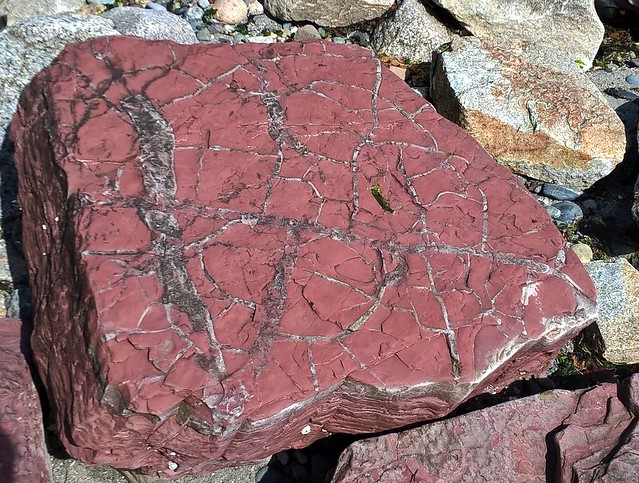
An absolutely scrumptious collection of fossilized mudcracks! Credit: Dana Hunter
Little critters, maybe worms or molluscs, burrowed in the sand and mud. Some of their burrows were later filled with more sediment that set up harder the surrounding material, making casts that erosion subsequently revealed.

A burrow cast in a sandstone boulder. Credit: Dana Hunter
So we've discovered a lot! We know these rocks have to be much younger than Precambrian. We don't know quite how old they are, but they are no older than the burrowing critters who made homes in them. Some of the layers probably represent a tidal environment like a mudflat, and others a floodplain. There must have been rivers, to carry the mud and silt down, perhaps also the sand. There wasn't a huge abundance of plant life, and the rivers don't seem to have been carrying much organic matter either. That's quite a bit of information from a jumbled set of rocks taken far from their context!
It reminds me very much of Arizona's Moenkopi Formation, in fact, and we'll visit with those rocks next. In the meantime, if you wish to become a rock detective and try to figure out where our out-of-context beauties come from, you're welcome to speculate at my Facebook page.