Signed by the Artist, Tagged by the Sea

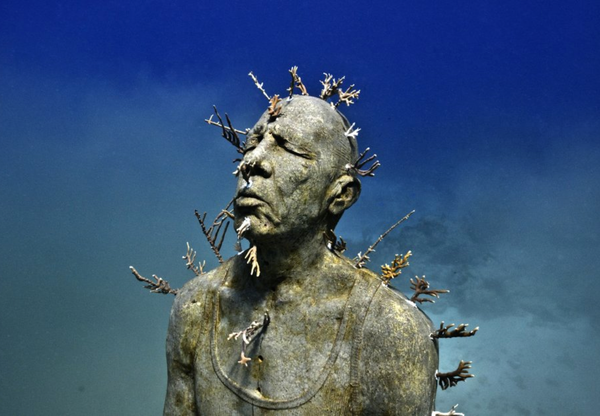
Most art is destined for the walls of a gallery where it would be frowned upon (to say the least) if you, say, decided to add a few thoughtful sharpie marks to a painting or two. But this artist invites collaboration by installing his sculptures on the bottom of the ocean and letting the sea creatures have their way with them.

Man on Fire; sclupture by Jason deCaires Taylor in the MUSA Collection, Isla Mujeres/Cancun, Mexico.

© Jason deCaires Taylor

This article was published in Scientific American’s former blog network and reflects the views of the author, not necessarily those of Scientific American


Yesterday we kicked off the September SciArt Blitz with Museo Atlántico, an underwater museum made of cast concrete figures and objects that will sit off the coast of the Canary Islands once completed, forming an artificial reef. The project is the latest underwater sculpture installation by artist Jason deCaires Taylor whose work dots the world’s oceans and makes powerful statements about politics, human activity, and climate change. Since Museo Atlántico is not completed yet, I promised to post an image of an older installation to show how the corals and algae take hold and continue to work on the sculptures long after Taylor’s hands have quit.

Jason deCaires Taylor's sculptures are submerged along shallow coastlines, attracting sea life and ultimately seeding a new shallow reef. This sculpture, titled Man on Fire, is off the coast of Cancun, Mexico. Image © Jason deCaires Taylor

You can find more of Jason deCaires Taylor’s work, including the progression of growth on sculptures visited at various intervals after their installation, at his website. Catch him also on Facebook and Twitter.


On supporting science journalism

If you're enjoying this article, consider supporting our award-winning journalism by subscribing. By purchasing a subscription you are helping to ensure the future of impactful stories about the discoveries and ideas shaping our world today.


Every September we here at Symbiartic take the opportunity to dish up a daily dose of sciart featuring all the incredible artists we haven’t been able to get to during the year. Curious to see the inspiring artists we’ve featured in the September SciArt Blitz over the years? Check out previous years’ galleries: 

2014  |  2013  |  2012

Subscribe to Support Independent Journalism

Great science journalism requires human expertise, time, effort and creativity. And it costs money. That’s why I and the journalists here at Scientific American hope you’ll join our community.

When you subscribe, you are supporting staff and freelance journalists who are passionate about telling science stories that are true, important and compelling. Our editors and reporters are often experts in their fields, which means they understand the nuances of big discoveries and can untangle the breakthroughs from the hype. With a subscription, you are also supporting rigorous fact-checking to ensure the words we publish are precise and accurate. And you’re supporting original illustrations, graphics and photos that bring you closer to an advanced laboratory, an ice sheet in Antarctica or a space mission in orbit. You’re helping us craft other types of high-quality journalism as well: Our newsletters are carefully written, edited and curated by staffers you have or will come to know and love. Our Science Quickly podcast is based on original reporting, collaboration with editors and scientists and exacting production.

Subscriptions keep this engine running so we can continue to deliver thoughtful, rigorous and independent science journalism to you. In an era of viral misinformation, this work is crucial. If you value what we do, I hope you’ll consider joining us as a subscriber

Thank you,

Jeanna Bryner, Editor in Chief, Scientific American

Subscribe