
This article was published in Scientific American’s former blog network and reflects the views of the author, not necessarily those of Scientific American
Welcome to the sixteenth edition of the MolBio Carnival! Some great blog posts on cellular and molecular biology have been submitted, many of them written by first-time contributors, so I urge you to check them all out. Let’s not waste any time and get this carnival started. It’s time to explore the most intricate machine of all: the living cell.
Inside the machine
Can you hear the hum? That’s the sound of biochemistry. Inside the cell, thousands of proteins are carrying out their tasks with clockwork precision. Cooperation is key here. Some proteins mesh together like gears: they depend on each other to function. Gemma Atkinson explains how such protein pairs co-evolve, hummingbird and flower as an analogy.
On supporting science journalism
If you're enjoying this article, consider supporting our award-winning journalism by subscribing. By purchasing a subscription you are helping to ensure the future of impactful stories about the discoveries and ideas shaping our world today.
Gears don’t turn themselves. We need a source of energy for our machine. We’re in luck: Christopher Dieni describes an enzyme that delivers sudden bursts of energy to keep the engines running. What’s more, this same enzyme can keep frozen frogs alive and assists in releasing insulin. Multipurpose design indeed!
While the main product of our cellular machine is life, there’s no reason we couldn’t tweak it to produce more. Lab Rat explains how we can let algae produce bioplastics, using a bacterial trick.
Woah.. Did you feel that rumble? Our cell is on the move! It unrolls its sticky proteins along the way to pull itself forward. The Leading Edge would like to study these sticky proteins in his or her test tube, but as it turns out, they prefer to remain attached to the surface instead.
Gremlins!
All machines are plagued by system failures, and sometimes even downright sabotage, and the cell is no exception. Viruses are the most notorious hijackers of cellular machinery. They usually come and go, but sometimes they become part of the machine themselves. EE Georgi describes how this happens.
Some gremlins cause more damage than others. HIV is one virus that certainly has earned its reputation of malevolence. EE Georgi joins in with another post, on whether gene therapy could eradicate this virus.
Bones can tell us about gremlins past. Lesions and pits in ancient bones sometimes represent the traces of ancient infections. Kristina Killgrove writes about palaeopathological evidence that the ancient Romans already suffered from Syphilis.
Connor Bamford continues along this line, and wonders if dinosaurs ever got the measles. Yes, he says! Or measle-like viruses, in any case. How do we know? Some dinosaur vertebra showed classical signs of Paget’s disease: remodeled bone and an increase in the amount of red blood vessels.
That’s it for this month’s edition of The MolBio Carnival. I hope you enjoyed this peek inside the machine, and you are welcomed to submit your best molbio blog articles to the next edition, which will be hosted by Connor (yes, that’s ‘dinosaur measles’ Connor!) from Rule of 6ix.
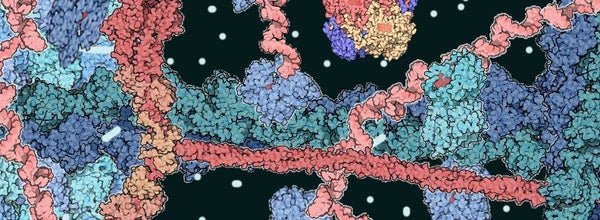
Images: Crowded cell by TimVickers.
