Beware the Pi of March

March 14 we celebrate the most popular of the mathematical symbols 3.14159265359


Join Our Community of Science Lovers!

This article was published in Scientific American’s former blog network and reflects the views of the author, not necessarily those of Scientific American


Happy Pi Day.


Happy Pi Day

Happy Pi Day!


Posted by Urban Science Adventures! © on Monday, March 14, 2016


On supporting science journalism

If you're enjoying this article, consider supporting our award-winning journalism by subscribing. By purchasing a subscription you are helping to ensure the future of impactful stories about the discoveries and ideas shaping our world today.


3.1416 - that's as far as I have ever remembered the value for Pi. And Lookit. That's today's date.

But what is Pi exactly?

Pi is the relationship between the diameter  (width of a circle) and it's circumference (the distance around the outside of the circle. Ok, I admit it. I had to look it up.
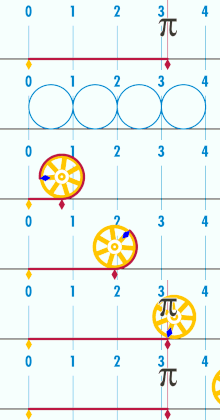
courtesy of wikipedia

But hey, don't take my and wikipedia's word for it. Go out and see for your self. 

Try this!

1. Take a cylinder such as a can or cannister.

2. Take a piece of string (yarn, ribbon, tape, etc) secure it across the exact middle of of the top. 

3. Measure that piece out (mark it or cut a piece).

4. Repeat this step or use the original string to cut out 3 additional pieces of string.

5. Now stretch out a longer piece of string.

6. Wrap another piece of string around the can. Mark or cut that piece.

Now lay out your strings and compare.

DNLee is a biologist and she studies animal behavior, mammalogy, and ecology . She uses social media, informal experiential science experiences, and draws from hip hop culture to share science with general audiences, particularly under-served groups.

More by DNLee

It’s Time to Stand Up for Science

If you enjoyed this article, I’d like to ask for your support. Scientific American has served as an advocate for science and industry for 180 years, and right now may be the most critical moment in that two-century history.

I’ve been a Scientific American subscriber since I was 12 years old, and it helped shape the way I look at the world. SciAm always educates and delights me, and inspires a sense of awe for our vast, beautiful universe. I hope it does that for you, too.

If you subscribe to Scientific American, you help ensure that our coverage is centered on meaningful research and discovery; that we have the resources to report on the decisions that threaten labs across the U.S.; and that we support both budding and working scientists at a time when the value of science itself too often goes unrecognized.

In return, you get essential news, captivating podcasts, brilliant infographics, can't-miss newsletters, must-watch videos, challenging games, and the science world's best writing and reporting. You can even gift someone a subscription.

There has never been a more important time for us to stand up and show why science matters. I hope you’ll support us in that mission.

Thank you,

David M. Ewalt, Editor in Chief, Scientific American

Subscribe