
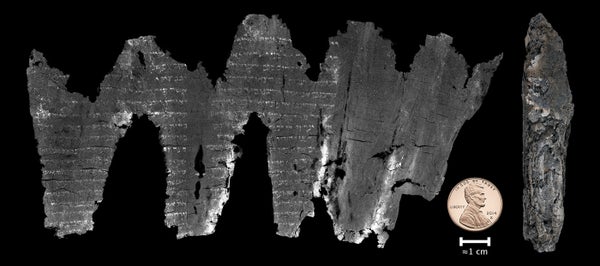

In the 1970s, researchers unearthing an ancient synagogue at Ein Gedi, near the Dead Sea, discovered the structure’s Holy Ark—the container in which early Jews would have stored the Bible as they prayed. The site was home to a large Jewish community from about 800 BCE until a huge fire there in about 600 CE. That fire blackened and burned the scrolls in the ark. They crumbled if touched. So the Israeli scientists locked them away. Until now.
Penina Shor at the Israel Antiques Authority reached out to computer scientist Brent Seales at the University of Kentucky to see if he and his colleagues could use new technologies to peer inside a scroll without unrolling it. They call the technique virtual unwrapping. Brent Seales explains:
“First we have to find the layers within the scanned volume. Finding evidence of those layers is called segmentation. So there's a process for that. Once we find those layers we create a texture on those layers that comes from the scanned volume itself and that's where the ink evidence gets situated onto the layered surface. And then the final step is this unwrapping where we flatten out that surface, which is not actually flat, it's three dimensional. So that we can merge the pieces together and see the completely unwrapped scroll.”
On supporting science journalism
If you're enjoying this article, consider supporting our award-winning journalism by subscribing. By purchasing a subscription you are helping to ensure the future of impactful stories about the discoveries and ideas shaping our world today.
They applied this technique to the Ein Gedi scroll.
“So the first time we saw the text was in the lab and of course I don't speak or read Hebrew but we knew that it was writing because of the systematic way the markings were lined up, our early versions were not as clear as what we were able ultimately to produce. But of course we were elated because we knew that we had a scroll in which we would see the writing.
“But I think the real joy came when Penina sent me back the result of having read our first results because then I knew that not only were we seen writing but it was readable because she and her team were able to identify it as a known text and at that point were absolutely jubilant I have to say.”
The Israeli scholars could clearly read the Hebrew. And they realized they were reading the book of Leviticus, one of the five books of Moses, the first five books of the Old Testament. It’s the earliest Biblical book found inside an Ark, and the earliest surviving book outside of the Dead Sea Scrolls. The finding is in the journal Science Advances. [William Brent Seales et al., From damage to discovery via virtual unwrapping: Reading the scroll from En-Gedi]
The researchers are thrilled not only with the discovery of the scroll’s writing, but with the potential to use this application to peer inside other scrolled texts.
“I believe there are more discoveries to come. Damage and decay is the natural order of things. But you can see this sometimes, you can absolutely pull a text back from the brink of loss.”
—Cynthia Graber
[The above text is a transcript of this podcast.]
[Seales audio from a AAAS telephone news conference on September 20.]
